

- About WXPress
- WXPress is your window into the world of WuXi AppTec and our global partners.
- Sitemap
- Events
- Contact
- Please reach out with any business inquires.
- communications@wuxiapptec.com
© 2026 WuXi AppTec. All Rights Reserved.Privacy Policy
In the theater of modern medicine, the spotlight is restless. In recent years, it has been among the surging technologies, such as CAR-T, mRNA, and peptide-based therapies. Each new modality arrives with a messianic aura, promising to succeed. Small molecules, the workhorses that shaped the pharmaceutical industry over more than a century, are increasingly cast in a supporting role—reliable, perhaps, but hardly the stuff of headlines.
The drama on stage, however, obscures what is happening backstage. Look at the actual numbers, and small molecules still command a starring role. In 2025, more than half of the 46 new drugs approved by the FDA's Center for Drug Evaluation and Research were small molecules. According to DXY Insight, the world's 100 bestselling medicines generated a combined $564.3 bn in 2025, with small molecules accounting for over 60% of that total. The top ten small-molecule drugs alone brought in more than $107 bn.
WuXi AppTec offers a useful window into this quiet persistence. The company handles a large number of small-molecule projects spanning every stage of development. Its latest interim report in 2026 showed revenue from small-molecule development and manufacturing jumping 72.7% year on year to RMB14.99bn (about $2.1bn). The pipeline reached 3,731 molecules, with 699 new ones added in just six months, 155 of them converted from in-house research (R) work, along with 15 new commercial and Phase III programs.
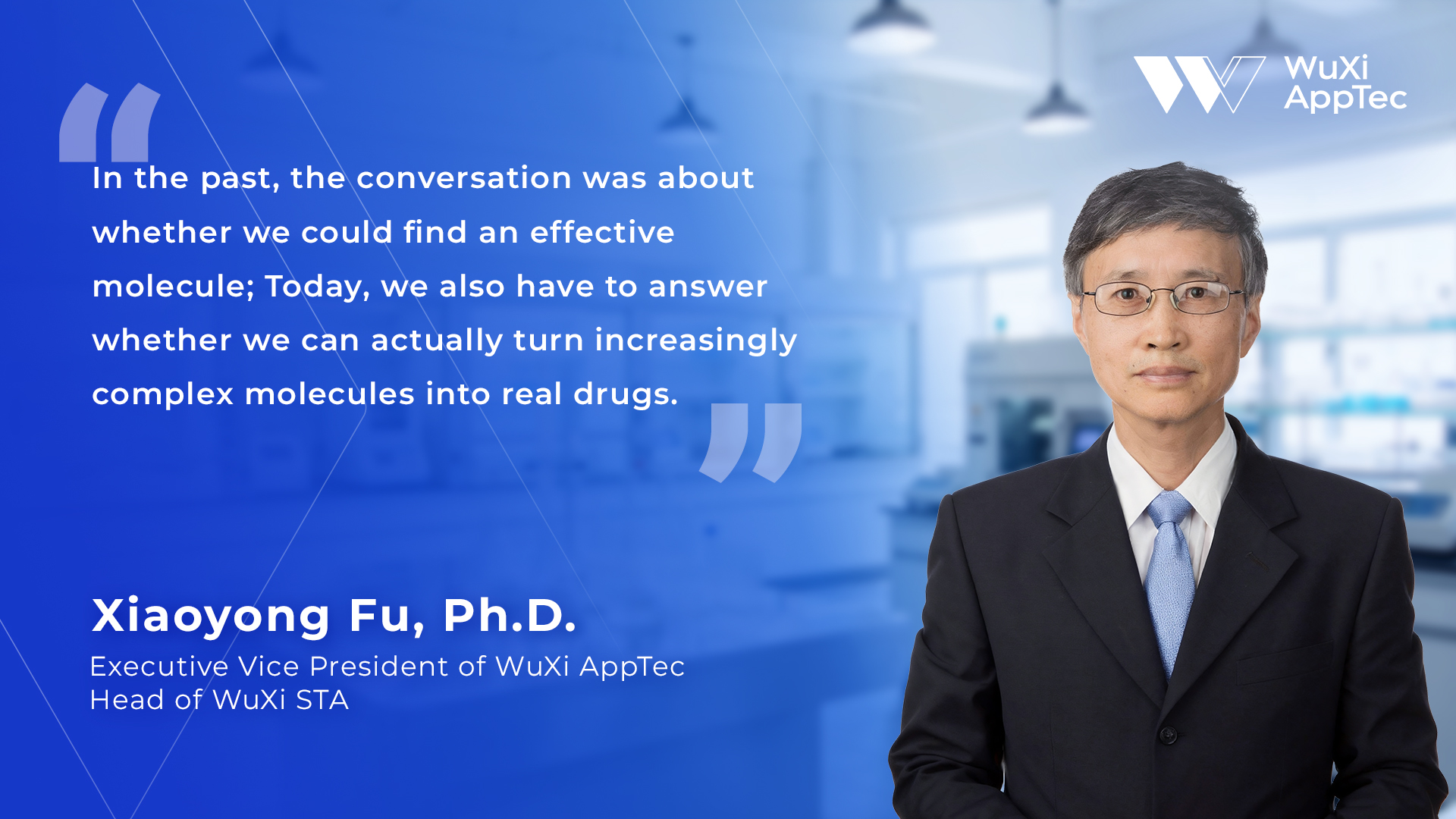
“Our growth is driven by the greater success of our customers' products,” says Dr. Xiaoyong Fu, Executive Vice President and Head of WuXi STA. “Behind these numbers is a steady stream of projects advancing from early research into late-stage clinical development and commercialization.” In Fu's view, the expansion of WuXi AppTec's small-molecule business also reflects, from a particular angle, the vibrancy of small-molecule innovation among its global clients.
The question is why. Having spent more than three decades in the industry, Fu has witnessed the small-molecule story unfold through many cycles. As the therapeutic toolbox grows ever richer, why do small molecules continue to hold their ground? And where will their next wave of growth come from?
The answer begins with a simple fact of chemistry. Small molecules are, as the name suggests, small. Their compact size and malleable structures allow them to slip through cell membranes and reach targets deep inside the cell—territory that larger biologics, which typically act on the cell surface or in the bloodstream, cannot easily access. For diseases of the central nervous system, where any would-be drug must cross the blood-brain barrier, this is a decisive advantage.
Small molecules also hold an advantage in how they are delivered. For chronic conditions such as hypertension, diabetes and dyslipidemia that require long-term treatment, adherence often hinges on convenience. Small molecules can generally be formulated more readily as oral drugs, and they benefit from a mature infrastructure for manufacturing, storage and large-scale supply. That makes them powerful tools for boosting patient compliance and broadening access to medicines—and for reaching vast patient populations.
“It's not just about whether a molecule can tackle a disease,” says Dr. Fu. “It's also about whether it can become a medicine that patients can use conveniently and obtain reliably.”
The rise of GLP-1 is instructive. Peptide drugs first opened up the obesity and metabolic disease market; oral small molecules then provided a new option. In April 2026, Eli Lilly's small-molecule GLP-1 drug Foundayo (orforglipron) won FDA approval. The once-daily pill can be taken without regard to food or water intake—a neat illustration of the convenience small molecules can deliver.
“The rise of a therapeutic area doesn't belong to a single type of molecule,” Dr. Fu notes. “Different disease mechanisms and patient needs will give rise to different solutions. Peptides validated the therapeutic value of GLP-1; oral small molecules have now further expanded patients' choices.”
Far from being a relic, the small molecule is quietly undergoing a reinvention. Its vitality runs deeper than the market tends to assume. “Looking at our clients' pipelines, small-molecule innovation remains very active,” says Dr. Fu.
New technologies like PROTACs (Proteolysis-Targeting Chimeras), molecular glues and covalent inhibitors are steadily expanding the repertoire of what a small molecule can do. Together, these approaches are opening routes to targets once dismissed as “undruggable.” At the same time, AI-driven discovery tools are helping researchers search, design and screen candidate molecules across a far wider chemical universe. Generative AI has already demonstrated a knack for proposing novel, synthesizable small-molecule structures.
Yet the very sophistication of these tools is pushing small molecules into new territory, and new complexity. The rule of thumb for decades was Lipinski's rule of five, a set of guidelines that included a molecular-weight ceiling of 500 daltons. Go much above that, the molecule would be too greasy, too insoluble, too unlikely to become a drug.
Today's pipeline is smashing through that ceiling. According to WuXi AppTec RCS team, the share of small molecules weighing more than 600 daltons has risen by 63% over the past five years. Synthetic routes stretching to 20, 30 or even 50 steps are becoming common.
“In the past, the conversation was about whether we could find an effective molecule,” says Dr. Fu. “Today, we also have to answer whether we can actually turn increasingly complex molecules into real drugs. New drug-hunting strategies and discovery tools have opened up more possibilities, but they have also pushed more challenges downstream into development and manufacturing.”
As more and more complex small molecules enter the pipeline, a practical question looms: how to shepherd them through the successive bottlenecks of process development, scale-up and commercial production?
For Dr. Fu, it is precisely the opportunity for WuXi AppTec to better empower its partners.
WuXi STA, the small-molecule engine within WuXi AppTec's chemistry business, provides integrated services spanning from active pharmaceutical ingredients to drug products, and from preclinical work all the way to commercial supply. Dr. Fu still recalls one project that arrived looking less like a drug candidate and more like a dare.
The synthetic route stretched across dozens of steps. The initial yield was measured in mere parts per million, meaning the target product amounted to only a few ten-thousandths of the theoretical output. It was, by any reasonable standard, unmanufacturable. The team tore up the original route and redesigned it from scratch, introducing enzymatic catalysis at critical junctures. The synthesis was shortened by more than ten steps, and the overall yield rose nearly a hundredfold. A molecule that had seemed destined to remain a laboratory curiosity suddenly had a path to commercialization. WuXi AppTec has since supplied hundreds of kilograms of the active ingredient to support clinical trials, and the drug recently received FDA approval. The project is now moving toward larger-scale production for commercial demand.
Such feats are not conjured from thin air. Over more than two decades, WuXi AppTec has built a comprehensive toolkit specifically designed to tackle the challenges of complex molecules. Dr. Fu points to a suite of technologies that WuXi STA has cultivated and steadily extended from the lab bench to commercial production: enzymatic catalysis, continuous manufacturing, spray drying, hot-melt extrusion and nanosuspension, among others. Each addresses a specific pain point: route efficiency, solubility, oral absorption, scale-up.
Just as importantly, the experience accumulated across thousands of projects, instincts for route design, impurity control, and scale-up can be reapplied to new ones, sparing clients from unnecessary cycles of trial and error.
But getting a complex molecule made is not the end of the road. If the R&D phase asks whether a molecule can be made, the commercial phase asks a tougher question: can it be delivered reliably, at scale, over the long term?
"What really determines whether a small molecule can reach patients is not whether you can make the first milligram in the lab," Dr. Fu says bluntly. "It's whether you can consistently produce it at kilogram scale and beyond, while meeting quality and supply requirements."
According to Dr. Fu, a global blockbuster drug posed an extraordinary challenge for WuXi STA in 2022. "It was the most urgent product we had ever manufactured, and the largest scale we had ever delivered," he revealed. In 2022 alone, WuXi STA efficiently produced over 200 metric tons of the API for this drug, successfully closing a massive global supply gap at the time." For the client, it was a supply risk defused," says Dr. Fu. "For patients, it meant their treatment could continue."
Today, WuXi STA's global network spans nine development and manufacturing sites. By the end of 2025, WuXi AppTec's total reactor volume for small-molecule active ingredients had surpassed 4 million liters. The company is pressing ahead with a new site in Changzhou, alongside additional capacity in Asia, Europe and North America, all calibrated to match the demands of projects as they advance from early clinical stages into full commercial production.
"As our platform capabilities and capacity expand, and as our global delivery network grows stronger, we can support more complex molecules in overcoming the obstacles of development and manufacturing, and pave the way for more complex new drugs to reach the market," says Dr. Fu.
The platform's value, in the end, is not to replace the client's role to complete innovation. It is to ensure that the scientific innovations already born do not stall somewhere along the way. From helping a complex molecule break through a development bottleneck to safeguarding the stable supply of a commercial drug, the mission is the same: fewer good ideas stranded mid-journey, and more of them reaching the patients who need them.
From a client's scientific idea to a medicine in a patient's hand, a molecule generates real value only with each step it takes forward. The vitality of small molecules is not best measured by how many can be dreamed up in a laboratory, but by how many can traverse the long and unforgiving chain of discovery, development and regulation to become treatments that patients can actually use.
WuXi AppTec's role, in this sense, is to keep the gates open. Its job is to help molecules clear the hurdles that separate research from development, and development from production—so that a client's scientific vision keeps moving forward, eventually becoming a medicine that reaches the people waiting for it. WuXi STA has supported the launch of more than 70 new drugs since 2017. Over the past year (as of Q2 2026), it has worked on more than 3,600 drugs spanning preclinical through late-stage trials, as well as over 90 commercial products.
"Our value is ultimately reflected in the progress of our clients' projects," says Dr. Fu. "Only when their molecules move from research to development, and from clinical trials to commercialization, do the technologies, quality systems and capacity we have built truly generate value. Client progress is the precondition for our own continued value creation."
And the endpoint of a client project is, ultimately, the patient.
"Every step forward for a client project means a promising molecule is one step closer to patients," Dr. Fu says. "Our vision—'every drug can be made, and every disease can be treated'—is not a claim that drug discovery has become easy. It is a belief that, through technology and collaboration, we can help more innovations overcome the obstacles that are solvable, so they can become medicines that truly serve patients."
The growth of WuXi AppTec's small-molecule business is not merely a corporate result. It is the notch left on a measuring stick by an industry grinding forward—one molecule at a time.