

- About WXPress
- WXPress is your window into the world of WuXi AppTec and our global partners.
- Sitemap
- Events
- Contact
- Please reach out with any business inquires.
- communications@wuxiapptec.com
© 2026 WuXi AppTec. All Rights Reserved.Privacy Policy
In recent years, drug development has increasingly moved toward precisely targeted therapies that can deliver greater therapeutic effects at lower doses. As emerging modalities such as targeted protein degraders and antibody-drug conjugates continue to advance, drug potency is increasing while required doses are decreasing. Although this trend creates opportunities for more effective therapies, it also places safety and quality-control demands on drug development and manufacturing that go far beyond those associated with conventional drugs. High-potency (HP) compounds represent one such field where the technical bar is particularly high.
A molecular glue degrader project from a biopharmaceutical company illustrates many of these challenges. The molecule was classified as OEB5, the highest occupational exposure band, required a 12-step synthetic route and had an ultra-low drug product dosage strength of just 0.03 mg. Together, these characteristics made the project highly challenging from the outset.
Under a conventional development model, a project of this complexity would typically require a longer timeline. Drawing on more than a decade of experience and integrated capabilities in high-potency drug development, WuXi STA, a subsidiary of WuXi AppTec, helped the client complete the full CMC scope—from API process development through IND submission—in just 8 months, delivering a high-quality regulatory package.
High-potency compounds are characterized by strong pharmacological activity at very low doses. Minute quantities can produce effects that may require much larger doses of conventional, non-high-potency drugs. The industry generally defines compounds with an occupational exposure limit (OEL) below 1 µg/m³ as high-potency compounds. An OEL represents the maximum airborne concentration of a chemical to which workers can be repeatedly exposed over a specified period without expected adverse health effects. While conventional drugs may be manufactured on a metric-ton scale, annual demand for high-potency drugs is often only a few kilograms to several tens of kilograms.
High-potency drugs are commonly found in oncology, cytotoxic therapies, and certain hormone-based therapies. As new molecular modalities continue to emerge, their applications are expanding. For example, highly potent compounds can be conjugated to small molecules, peptides, nucleic acids, carbohydrates, or even biologics, enabling more precise delivery to cancer cells or viral targets.
Targeted protein degraders provide another example. By inducing or stabilizing protein-protein interactions, these molecules can exhibit catalytic behavior: rather than being consumed in the process, the drug molecule can repeatedly induce degradation of the target protein. This property enables some degraders to produce substantial pharmacological effects at very low doses. As a result, many such molecules need to be handled as high-potency compounds during development and manufacturing to help ensure safe operations.
Despite their therapeutic potential, the strong pharmacological activity and inherent toxicity of high-potency compounds impose stringent requirements on both development and manufacturing. Whether for APIs or drug products, these programs require highly contained facilities, robust process development capabilities, specialized manufacturing expertise, and comprehensive quality and safety management throughout the development lifecycle.
WuXi STA has been working in the high-potency pharmaceutical field for more than a decade. Since 2012, the company has continued to build its high-potency drug development and manufacturing platform in response to evolving industry and client needs. The facilities have a Containment Performance Target (CPT) designed to meet the control requirements for compounds with occupational exposure limits (OELs) as low as 10 ng/m³. Today, it is equipped with multiple high-potency process R&D labs, kilo labs, and plants along with various process technologies such as milling, flow chemistry, hydrogenation, and preparative HPLC and lyophilization, offering a one-stop high-potency API platform spanning process development through commercial manufacturing.
Beyond API services, WuXi STA provides integrated CMC services for high-potency drug products, including oral and injectable formulations. Its high-potency oral drug product manufacturing facilities support processes including wet and dry granulation, tablet compression, coating, and capsule filling, enabling the manufacture of both tablets and capsules. The high-potency injectable manufacturing facility utilizes fully enclosed isolation systems and automated filling machines. This design effectively minimizes human intervention, preventing cross-contamination and ensuring stringent quality assurance for sterile products.
To date, WuXi STA has supported more than 40 integrated high-potency projects covering drug substance and drug product and has released more than 300 clinical batches.
Leveraging its established integrated high-potency capabilities, WuXi STA also provides end-to-end process development and manufacturing services for highly potent small-molecule payloads, linkers, and payload-linker constructs. Through collaboration with WuXi TIDES, part of WuXi AppTec, these capabilities can further support clients developing a broad range of conjugated therapeutics.
This depth of experience provided the foundation for WuXi STA to address the challenges presented by high-potency drug development.
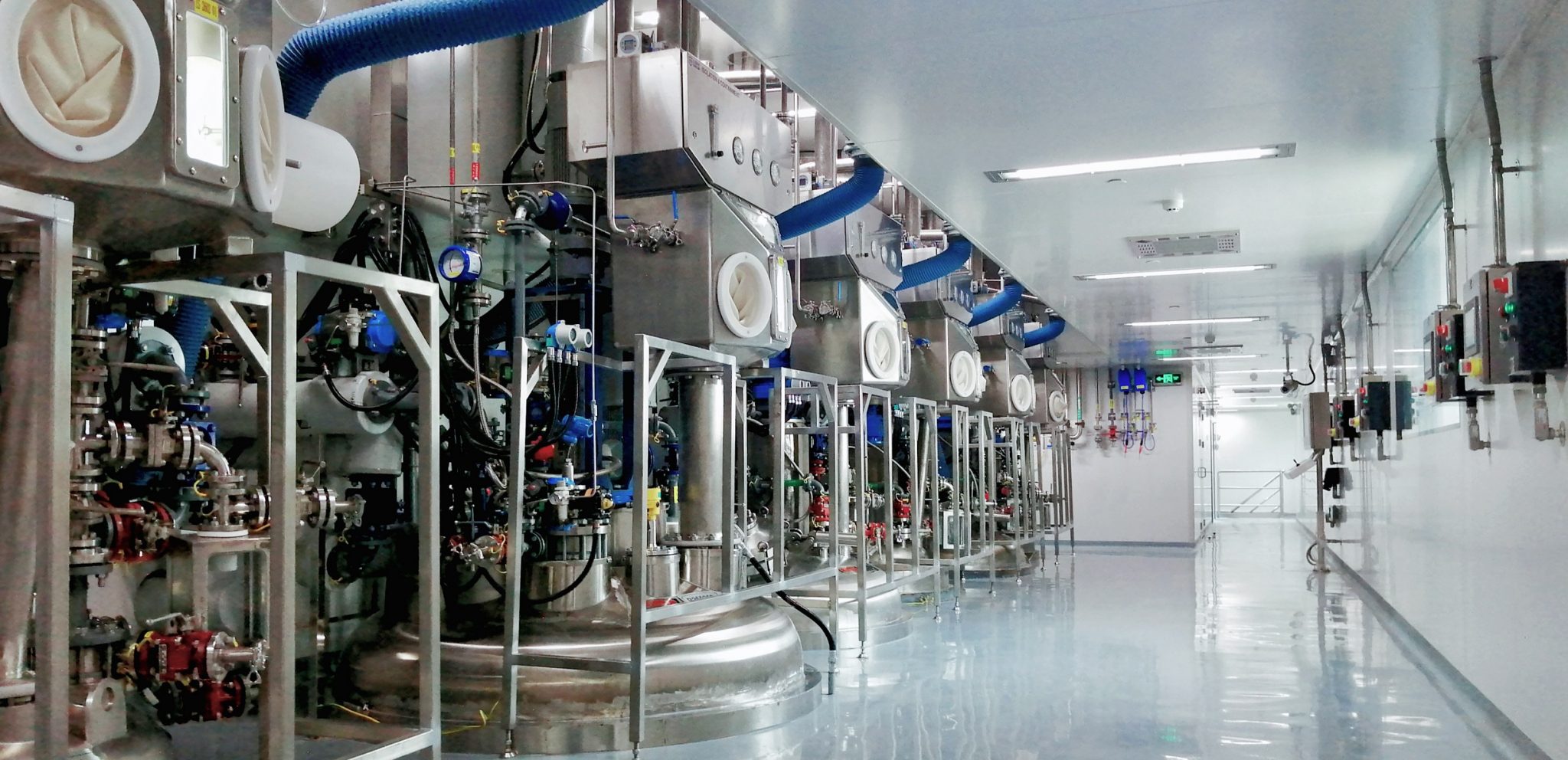
▲WuXi STA high-potency API plant (Image source: WuXi STA)
The molecular glue degrader presented challenges across both API and drug product development.
On the API side, the compound was classified as OEB5—the highest occupational exposure band for high-potency compounds—requiring dedicated high-potency facilities, specially trained personnel, and rigorous safety protocols. In addition, the synthetic route involved more than twelve steps and multiple purification stages, while the final compound exhibited poor storage stability.
On the drug product side, the ultra-low dosage strength of just 0.03 mg created significant challenges for conventional formulation and analytical approaches. The API was prone to adsorption onto equipment surfaces, potentially resulting in both material loss and cross-contamination risks. More importantly, the ultra-low dose required exceptionally tight content uniformity, while the need for highly sensitive analytical methods further increased project complexity.
To address these challenges, the WuXi STA team developed a systematic solution.
For API process development and manufacturing, the process team conducted systematic solid-form screening and optimized the crystallization process in the OEB5 lab to identify a stable polymorph, effectively preventing degradation and polymorphic transformation during storage. Following process optimization, the overall yield under GMP manufacturing conditions increased by more than 10%, purity exceeded 99%, and impurities were well controlled. Within just four and a half months, the team delivered several kilograms of API, providing sufficient material for subsequent drug product development.
For the drug product, the team relied on the dedicated high-potency manufacturing facility and employed fluid bed granulation and suspension spraying techniques. Through multiple stages of uniform dispersion and liquid suspension spraying, the approach enabled highly homogeneous distribution of the active ingredient throughout the excipient matrix.
Ultimately, the relative standard deviation (RSD) for content uniformity was below 2.0%, well below the 6.0% criterion specified in USP/EP standards. For an ultra-low-dose drug product, a lower RSD indicates greater consistency in API content between individual dosage units—an important quality attribute related to both efficacy and safety.
Impurity control represented another challenge throughout the project. In high-potency programs, product contact material (PCM) assessment is an important strategy for controlling potential unknown impurities. WuXi STA used filler excipients to simulate manufacturing batches and pre-assess the equipment, systematically evaluating product-contact materials and surfaces to help ensure that potential impurities remained under control.
The team also developed a sensitive high-performance liquid chromatography (HPLC) method capable of simultaneously measuring API content and related impurities, enabling reliable quality control even at the ultra-low dosage strength.
From project initiation through support for the client's IND submission, the entire program was completed in just 8 months, significantly shortening the overall development timeline. This acceleration was enabled by the systematic coordination of WuXi AppTec's integrated platform.
Rather than waiting for API development to be completed before beginning subsequent activities, preformulation studies and drug product development were initiated while API process development, optimization, and manufacturing were still underway. In parallel, analytical method development, validation, and release testing supported both API and drug product development throughout the program. All operations were conducted in fully enclosed OEB5 labs and GMP plants to ensure containment.
As a result, individual stages no longer operated as isolated steps in a linear sequence. Instead, multiple activities progressed in parallel as part of a coordinated workflow. Inefficiencies commonly encountered in fragmented development models—including waiting between stages, repeated analytical method handovers, and validation—were systematically reduced.
For high-potency compounds in particular, the benefits of this integrated model are especially apparent. From process scale-up through manufacturing, materials can be handled within a fully contained chain, reducing cross-contamination and occupational exposure risks associated with movement between different stages or facilities.
At the same time, cross-functional teams can work together to optimize the synthetic route, specialized formulation processes, and contained filling approaches in parallel, helping accelerate the overall program. In this project, the result was not only a shorter timeline but also greater assurance of consistent quality throughout development.
As the clinical applications of high-potency drugs continue to expand, enabling more high-potency molecules with therapeutic potential to reach the clinic faster and with robust quality remains an important priority for the industry.
WuXi AppTec will continue to collaborate with global partners, leveraging its integrated platform to help clients accelerate the advancement of innovative therapies from the laboratory to the clinic—and ultimately to the patients who need them.