


- About WXPress
- WXPress is your window into the world of WuXi AppTec and our global partners.
- Sitemap
- Events
- Contact
- Please reach out with any business inquires.
- communications@wuxiapptec.com
© 2026 WuXi AppTec. All Rights Reserved.Privacy Policy
It’s been nearly two decades since Dr. Donald Ingber first envisioned the Wyss Institute—a bold idea rooted in the belief that engineering principles, when combined with a deep understanding of biology, could unlock transformative solutions in medicine and beyond. Today, that vision is a thriving reality. The Wyss Institute has become a model for translational science, pioneering technologies such as organs-on-chips and bioinspired materials, and launching more than sixty startups that are actively shaping the future of healthcare. We recently sat down with Dr. Ingber to explore how the Institute’s unique structure has “turbocharged the skunkworks of academia,” accelerating innovation in ways rarely seen in traditional academic settings.
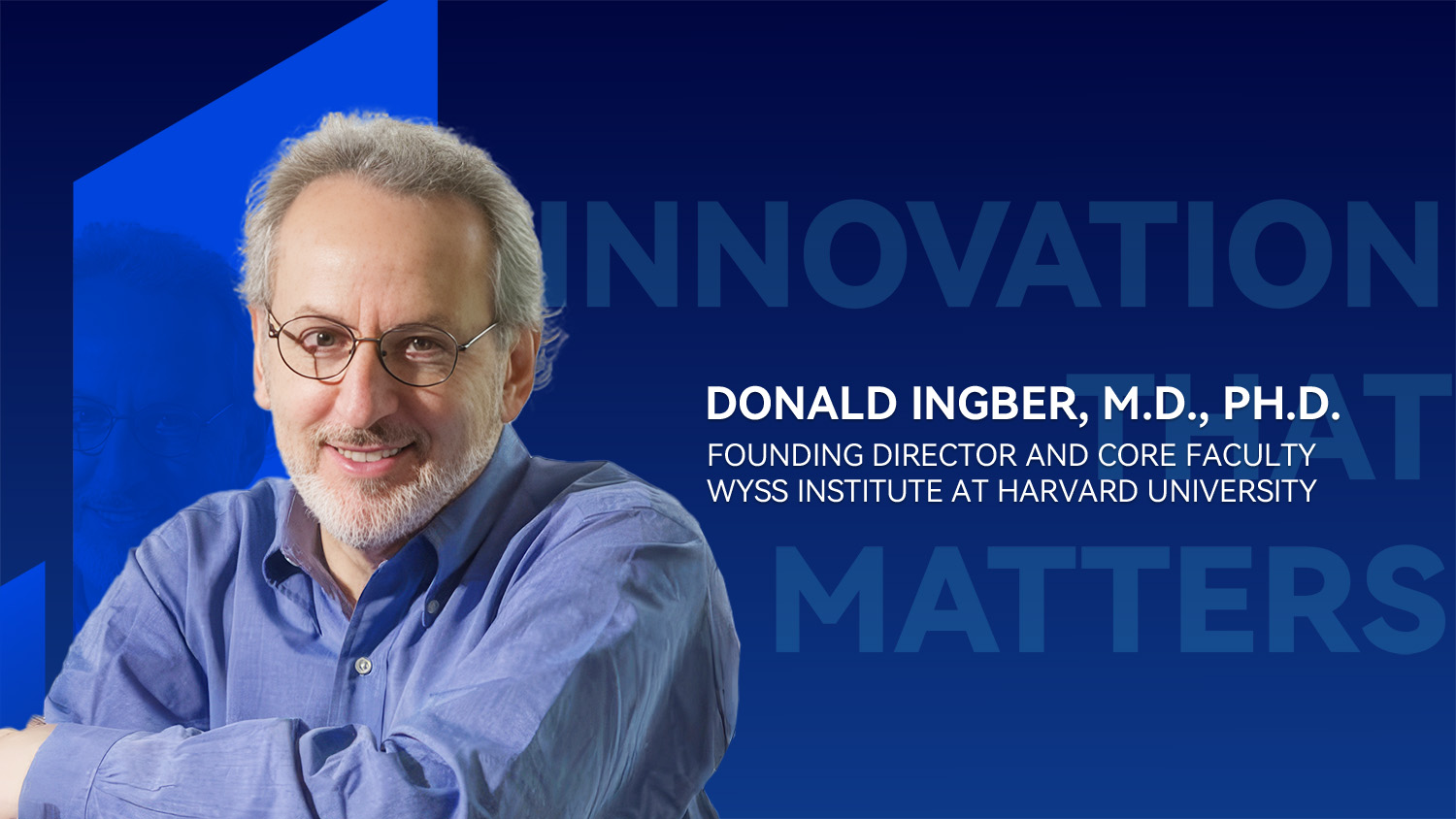
Don, it’s great to speak with you. The Wyss Institute is often described as a place where engineering and biology truly converge. How do you define "translation" in the context of your work?
Donald Ingber: The Wyss Institute was created to help engineer the future. We began thinking about this nearly 20 years ago and officially launched the Institute 16 years ago. We believe that discoveries made at the bench won’t have a real-world impact unless they move beyond the lab. When it comes to translation, this design perspective shapes how we invent. Synthetic biology is a major part of our work—using genetic engineering and other tools to reprogram cells, tissues, and even whole organisms, or to develop shuttles that cross the blood-brain barrier—be it engineered proteins or viral vectors. We’re blending biology and engineering to build the next generation of therapeutics, diagnostics, devices, and biomaterials.
Recently FDA announced a plan to reduce reliance on animal testing in preclinical safety studies included in Investigation New Drug applications, and listed organ-on-a-chip technologies as a potential alternative. As a pioneer in this field, what were the key inflection points that helped move it from an academic concept to something with real-world impact?
Donald Ingber: The organ-on-a-chip technology emerged from my lab right around the time the Wyss Institute was launching. It started with a postdoc project and was built on techniques we had been developing for almost two decades—adapting methods from computer microchip manufacturing and applying them to biology and living cells. We created devices lined with living cells, containing hollow channels that mimic physiological functions—like breathing motions in the lung or peristaltic movements in the intestine. We had to prove that these chips could truly replicate human organ-level functions. That meant refining the biology, engineering better devices, and developing instruments that could support long-term culture and function.
But de-risking went far beyond the science. We engaged directly with pharmaceutical companies—these collaborations were critical not just for validation, but for understanding what industry actually needed. Would they want something that fits on a lab bench or a larger system? What kind of user interface would be ideal? These partnerships helped us refine the product-market fit.
At the Wyss Institute, we also built a strong internal team—about 50 people with deep product development experience, including many who had worked in startups or pharma. Some had backgrounds in cell-based toxicity testing, others in commercializing biotech tools. So we didn’t just de-risk the technology—we de-risked the entire translation pathway.
That’s a great example. At Wyss Institute, how do you prioritize which technologies to move toward commercialization? Is it based on potential impact, feasibility, or industry interest?
Donald Ingber: The Wyss Institute operates under a very unique model—unlike anything I’ve seen elsewhere. In a way, we’ve turbocharged what I call the “skunkworks of academia.” Our faculty have open access to the Institute’s platforms and receive internal funding to support postdocs and students. Importantly, they maintain complete creative freedom. We don’t move in entire faculty labs on site—just the more entrepreneurial, technology-driven people from each group.
One of our key strategies is to encourage early reporting of inventions. We have strategic intellectual property attorneys on site—not to write patents, but to offer early, actionable feedback. They’ll look at a report of invention and say, for example, “This isn't patentable as-is, but if you tweak A, B, and C, it could be highly valuable.” That allows researchers to refocus early and be sure that they are on the shortest path to impact.
Later in the process, we have an internal application for what we call Validation Projects. These often arise when a team begins to self-assemble—frequently including postdocs, students, along with technical staff who have industry experience. They submit a short proposal—usually about 5 pages—describing an initial high-value application, technical milestones, and a one to two-year timeline. They essentially begin forming a startup-ready team, pulling in our business development staff and IP experts to build a go-to-market strategy, IP landscape, and freedom-to-operate analysis.
Most of these projects spin out as startups, often following a high-impact publication and early investor interest. But sometimes, investor feedback highlights a need for additional technical or commercial de-risking. If multiple investors echo the same concerns, teams can apply for support as an Institute Project. These receive funding to address specific gaps identified by potential investors—whether it’s additional preclinical data, manufacturing cost reduction, or regulatory strategy.
We’ve done everything from running a Phase 1 trial for a cancer vaccine later licensed by a pharmaceutical company, to developing a shoe insole that restored balance in a clinical study with elderly to that of 20-year-olds—where we had to reduce manufacturing costs more than tenfold. That’s not the kind of work you typically see in an academic environment. It’s what makes the Wyss Institute truly different: we don’t just develop technology—we build the full pathway to real-world impact.
Can you also share examples that didn’t go as planned? What can we learn from that experience?
Donald Ingber: Absolutely. Sometimes the idea is right—but it’s just too early. Timing can be everything. Back in 1998, I founded a startup focused on 3D printing of medical devices and other materials for various applications. It was the right idea, but way too early for the market. We were just ahead of our time.
Another example—one I thought would be a blockbuster—was a project we published in Science in 2012. The idea was inspired by how platelets respond to narrowing in blood vessels, which creates high shear stress and triggers clot formation. We thought: what if we could mimic that mechanism to deliver drugs specifically to sites of vascular obstruction, like in heart attacks, strokes, or pulmonary embolisms? These are conditions where clot-busting drugs can save lives—but only if administered quickly, and they come with major risks like systemic bleeding. So, we developed nanoparticle aggregates—about the size of a platelet—using a scalable spray-drying technique. We coated them with clot-busting drugs, and in animal models of pulmonary embolism, we saved 85% of the animals using just 1% of the typical drug dose. It was incredibly promising.
But then came the hurdles. We couldn’t get access to tissue plasminogen activator (tPA), and no one wanted to license it for this use because the stroke market had a history of failure. Venture capitalists wouldn’t take the risk. Others raised concerns about manufacturing scale-up.
We later pivoted and used this technology to deliver nitroglycerin instead—a widely available, low-cost vasodilator. We’ve now shown in preclinical models of ischemic stroke that nitroglycerin-loaded particles restore blood flow through collateral vessels, reduce neurological damage, and avoid the usual systemic side effects. We just submitted a paper on it and are finally getting serious investor interest—13 years later.
So while it hasn’t succeeded yet, it might still. What’s held it back hasn’t been the science—it’s been the commercial barriers: timing, risk tolerance, access to key partners. In my experience, most failures aren’t about the idea or the data. They come down to two things: people and timing. Either the team dynamics break down, or the commercial ecosystem just isn’t ready for the leap. That’s where the biggest lessons often lie.
Looking ahead, how do you see the process of translation evolving over the next decade? Where do you think the next frontier lies, and how do you see institutions like yours evolving to meet those opportunities?
Donald Ingber: We've already begun exploring and implementing new models that are showing real promise. One of the most exciting developments is our early-stage collaboration with venture capital firms. These firms are now providing unrestricted support for the early part of our innovation pipeline—what I call the "left side" of our innovation funnel, or the skunkworks. In addition, they are then funding some of our Validation Projects, which are often the seeds of startups. Instead of waiting for de-risked technologies to emerge, they’re helping to shape and support them from the ground up—sometimes even assembling external teams to work in parallel with our internal ones. This type of deep, early collaboration is already producing some very promising startups.
Another promising model we’ve developed is a pre-competitive consortium focused on solving one of the biggest bottlenecks in neurotherapeutics: crossing the blood-brain barrier. We saw that nearly every major company struggles with this challenge—especially with biologics for diseases like Alzheimer’s and ALS, where over 95% of drug candidates fail. In conversations with pharma and biotech companies, we realized something important: they all want to protect their own drugs, but they’re open to sharing delivery technologies. That insight led us to launch a pre-competitive consortium where we develop and license novel BBB shuttles non-exclusively to multiple companies. It’s a win-win: companies retain their proprietary drugs, and the shuttles get broadly adopted faster.
So, if I had to sum it up: at the Wyss Institute, we experiment with commercial collaboration types, things that Harvard's never done before, we've never done before, companies have never done before. And that’s exactly what’s needed to unlock the next frontier.
Thank you for your insights!