


- About WXPress
- WXPress is your window into the world of WuXi AppTec and our global partners.
- Sitemap
- Events
- Contact
- Please reach out with any business inquires.
- communications@wuxiapptec.com
© 2026 WuXi AppTec. All Rights Reserved.Privacy Policy
As the global burden of neurological diseases continues to rise, the need for effective treatments for complex CNS (central nervous system) disorders has never been more urgent. At the forefront of addressing this challenge is Roche, one of the world’s leading innovators in neuroscience translational research. Over the past decade, Roche has made significant progress in bringing new therapies to patients, with recent approvals for conditions including multiple sclerosis, spinal muscular atrophy, neuromyelitis optica, and Duchenne muscular dystrophy. In a major step forward, Roche announced in April 2025 the initiation of a Phase III program for trontinemab, a next-generation Alzheimer’s therapy that leverages the company’s brain shuttle platform to more effectively cross the blood-brain barrier—a long-standing hurdle in neurological drug development. With this momentum, we sat down for an exclusive conversation with Dr. Azad Bonni, SVP and Global Head of Neuroscience & Rare Diseases at Roche pRED, to discuss how Roche is accelerating research and development and why we may be entering a new era of meaningful breakthroughs for patients affected by devastating CNS diseases.
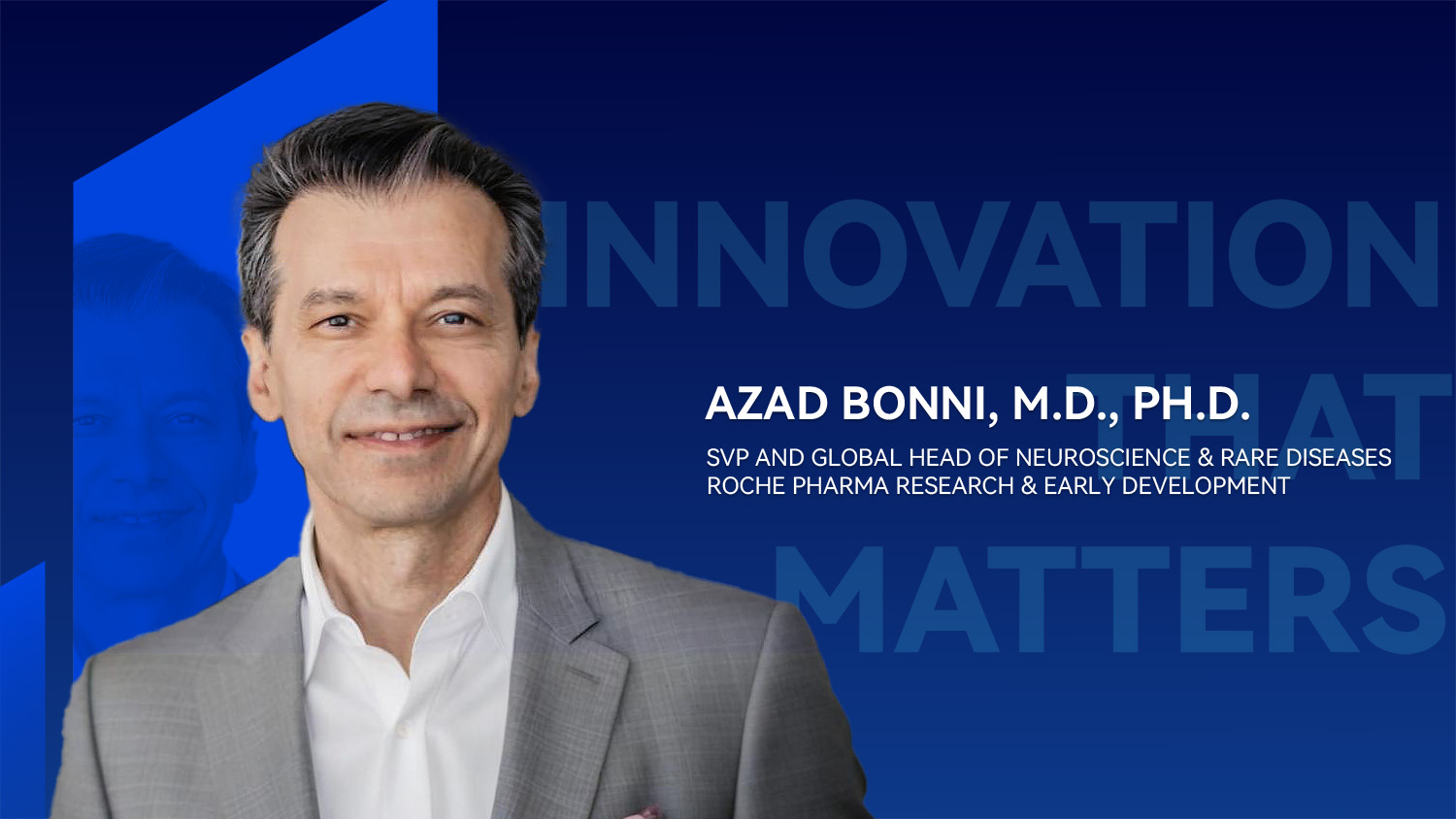
Thank you for joining us, Dr. Bonni. As a global leader in neuroscience, how does Roche envision making meaningful progress in addressing complex CNS diseases?
Azad Bonni: Neuroscience therapeutics has long been considered one of the most challenging areas in medicine—often described as a “graveyard for pharma.” But I believe we are now on the cusp of major breakthroughs in this field. If you look at the history of neuroscience therapeutics—from the lens of Roche—it illustrates this point well. In the 1960s, Roche developed benzodiazepines, starting with Librium and Valium. It then took another decade before launching Madopar for Parkinson’s disease, and two more decades before introducing tPA for acute stroke through Genentech, now part of Roche. For much of the 20th century, new classes of therapies in neuroscience were sparse—perhaps one every decade or two.
Starting in 2017, that pace changed dramatically. We launched Ocrevus for multiple sclerosis, Evrysdi for spinal muscular atrophy, Enspryng for neuromyelitis optica spectrum disorders, and now Elevidys for Duchenne muscular dystrophy. That’s four major launches within a relatively short period—something we hadn’t seen before in this space. And this isn’t a coincidence; it signals that we’ve reached a real turning point.
What excites me even more is that we’re now making meaningful progress in major prevalent disorders like Alzheimer’s disease and Parkinson’s disease—areas that have historically been incredibly challenging. In Alzheimer’s, we’re advancing trontinemab, which utilizes our innovative brain shuttle technology, and nivegacetor, a gamma secretase modulator. In Parkinson’s, we’re developing prasinezumab, which targets aggregated alpha-synuclein, a key pathological hallmark of the disease.
Several factors are driving this progress. First, advances in human genetics have provided critical insights into disease mechanisms. Second, our understanding of disease biology has significantly improved. And third, new technological platforms are accelerating discovery and development. Together, these advances create a strong foundation for why we believe neuroscience therapeutics is entering a new era of meaningful progress.
You mentioned both small molecules and antibodies. How does Roche approach modality selection when targeting CNS diseases?
Azad Bonni: For a long time, small molecules have been the primary therapeutic approach in neuroscience, and they will certainly continue to play an important role. Small molecules offer several advantages, and there have been significant advances in this area in recent years.
At the same time, large molecules—such as biologics—are becoming increasingly relevant. The main challenge with large molecules in neuroscience has always been the blood-brain barrier, which, while essential for protecting brain function, also makes it incredibly difficult for therapeutics to reach brain tissue. That’s where innovations like our brain shuttle technology come in. This platform allows us to effectively bypass the blood-brain barrier and deliver therapies directly to the brain, opening up entirely new possibilities for treating neurological diseases.
So, to answer your question directly—there’s no one-size-fits-all approach. We need to apply multiple modalities and fully leverage the expanding range of therapeutic options to address the complex challenges of nervous system disorders. And that’s exactly what we’re doing at Roche and across the field.
Many drug developers struggle with the translational ‘valley of death.’ What does Roche do differently to more effectively bridge early discovery and clinical development?
Azad Bonni: Thanks to the scientific advances I mentioned earlier, we can now approach drug development in neuroscience in a fundamentally different—and more modern—way than in the past. This means focusing on diseases where there’s strong genetic evidence and a decent biological understanding of disease pathogenesis, and where we can apply cutting-edge technological platforms. In other words, we prioritize disease areas and targets that offer relatively high biological confidence. While we’re still in the early stages of translating that into clinically validated targets in neuroscience, we’re making steady progress.
Another critical factor is improving the predictive validity of preclinical models—ensuring that what we learn in research better reflects what will happen in humans. That’s an ongoing effort. Equally important is the development of better biomarkers. Robust biomarkers are essential to guide decision-making along the value chain. Together, these factors—targeting high-confidence biology, improving translational models, and developing better biomarkers—are key to overcoming the “valley of death” you described.
Many companies have historically focused on neuroscience, but over time the field lost momentum. Recently, however, we’ve seen a resurgence of activity and renewed enthusiasm. In your view, what’s fundamentally different this time, and what steps can be taken to avoid repeating the cycles of attrition we’ve seen in the past?
Azad Bonni: That’s a great question, and I fully agree with you—there’s a clear renaissance happening in neuroscience, and I believe it will continue to accelerate throughout this decade and the next.
One critical factor I want to highlight is the role of biomarkers. Take Alzheimer’s disease as an example. Despite more than 25 years of work on amyloid-targeting therapies and many high-profile failures, those setbacks led to significant advances in our understanding of the disease and in developing biomarkers. These biomarkers have fundamentally changed how we approach drug development. They allow us to ask precise scientific questions, both preclinically and in clinical trials, and enable proof-of-mechanism studies—helping us determine early on whether a drug is doing what it’s supposed to do before committing significant time and resources to later-stage development.
This experimental medicine approach has been critical to the recent progress in Alzheimer’s, and we now need to apply that same mindset to other diseases—Parkinson’s and beyond. While there’s still more to do even in Alzheimer’s, the collaborative efforts of pharma, biotech, and academia have created a strong foundation through biomarker development. That model can—and should—be extended to other complex neurological diseases.
Beyond biomarkers, what other technologies is Roche exploring that you believe could fundamentally transform how we discover and translate medicines over the next five years?
Azad Bonni: One technology I’d really like to highlight is our brain shuttle platform. While there are many exciting technologies in development, I believe this one has the potential to fundamentally change how we deliver therapies to the brain. As I mentioned earlier, the blood-brain barrier prevents large molecules like antibodies from entering the brain. With conventional antibodies, typically only about 0.1% reaches the brain, and even then, the distribution is limited, often concentrated around the ventricles rather than throughout the brain tissue.
The brain shuttle technology addresses this challenge by leveraging natural transcytosis mechanisms—the body’s way of transporting substances across the barrier. Through advanced protein engineering, we’ve developed molecules like trontinemab, an antibody that targets aggregated amyloid plaques in Alzheimer’s disease. Trontinemab is engineered to include a moiety that binds to the transferrin receptor, enabling it to actively cross the blood-brain barrier through transcytosis. Importantly, this engineering ensures that the antibody behaves properly both in peripheral circulation and once inside the brain, avoiding unwanted accumulation in endothelial cells lining the blood vessels.
Trontinemab is currently our most advanced asset using this technology. In a Phase 2a trial, it demonstrated rapid and robust depletion of amyloid plaques, dramatically more than conventional antibodies. What’s also exciting is that it showed a lower incidence of ARIA (amyloid-related imaging abnormalities)—a common adverse effect seen with traditional amyloid therapies. We believe this may be related to the different route of entry into the brain.
But the potential of the brain shuttle goes far beyond amyloid and Alzheimer’s disease. This platform can be applied to other antibodies, a range of neurological diseases, and even beyond antibodies to other modalities, opening up entirely new possibilities for treating diseases of the brain.
For my final question—if you had a magic wand and could make one wish come true in neuroscience, what would it be?
Azad Bonni: That’s a great question. One area I’ve been thinking about lately is preventive neurology. In cardiology, for example, prevention is already well established—with treatments like antihypertensives, statins, and now GLP-1 agonists aimed at addressing risk factors before serious disease develops. I believe we will approach a similar turning point in neurology.
To give some context in the example of Alzheimer’s, by the sixth decade of life, it’s estimated that up to 40% of people already have amyloid pathology in the brain, even if they show no symptoms. Now imagine a future where accurate diagnostic tests identify these individuals early, and we have targeted therapies to prevent progression to symptomatic disease. This is the kind of future I’m excited about—and one I believe is increasingly within reach.
At Roche, we’re uniquely positioned to lead this transformation because we have both a pharmaceutical and diagnostics division, and we’re global leaders in neurology across both areas. This gives us a unique ability to advance precision-type, preventive approaches that could fundamentally change how we manage neurological diseases. Of course, this doesn’t mean we’ll stop focusing on treatments for people who already have symptoms—that remains critical as long as unmet medical needs exist. But as societies become more focused on maintaining health and quality of life, secondary prevention—intervening before symptoms emerge—will become an increasingly important part of the future of medicine. And I’m truly excited to be part of shaping that future.