


- About WXPress
- WXPress is your window into the world of WuXi AppTec and our global partners.
- Sitemap
- Events
- Contact
- Please reach out with any business inquires.
- communications@wuxiapptec.com
© 2026 WuXi AppTec. All Rights Reserved.Privacy Policy
September 21st marks World Alzheimer’s Day, a crucial time to raise awareness about Alzheimer’s disease (AD) and to honor the remarkable progress made in treatment over the years. Alzheimer's disease, a relentless neurodegenerative disorder, impacts millions worldwide, causing cognitive decline and memory loss. Despite these challenges, the fight against Alzheimer's has seen extraordinary breakthroughs, driven by industry collaboration and relentless innovation, offering hope and improved quality of life for patients and their families.
Every 3.2 seconds, someone in the world is diagnosed with Alzheimer's disease. Globally, more than 50 million people are affected, a number projected to rise to 139 million by 2050. The disease not only devastates patients but also places immense emotional and financial strain on families and caregivers. The cost of Alzheimer's in the U.S. exceeds $360 billion annually, underscoring the urgent need for effective treatments.
The history of Alzheimer’s treatment is a testament to scientific progress and industry cooperation. The past few decades have witnessed the approval of several groundbreaking therapies that have transformed the landscape of Alzheimer’s treatment. The first class of drugs approved for Alzheimer's were cholinesterase inhibitors, such as donepezil (Aricept), rivastigmine (Exelon), and galantamine (Razadyne). These drugs work by increasing levels of acetylcholine, a neurotransmitter involved in memory and judgment, providing symptomatic relief.
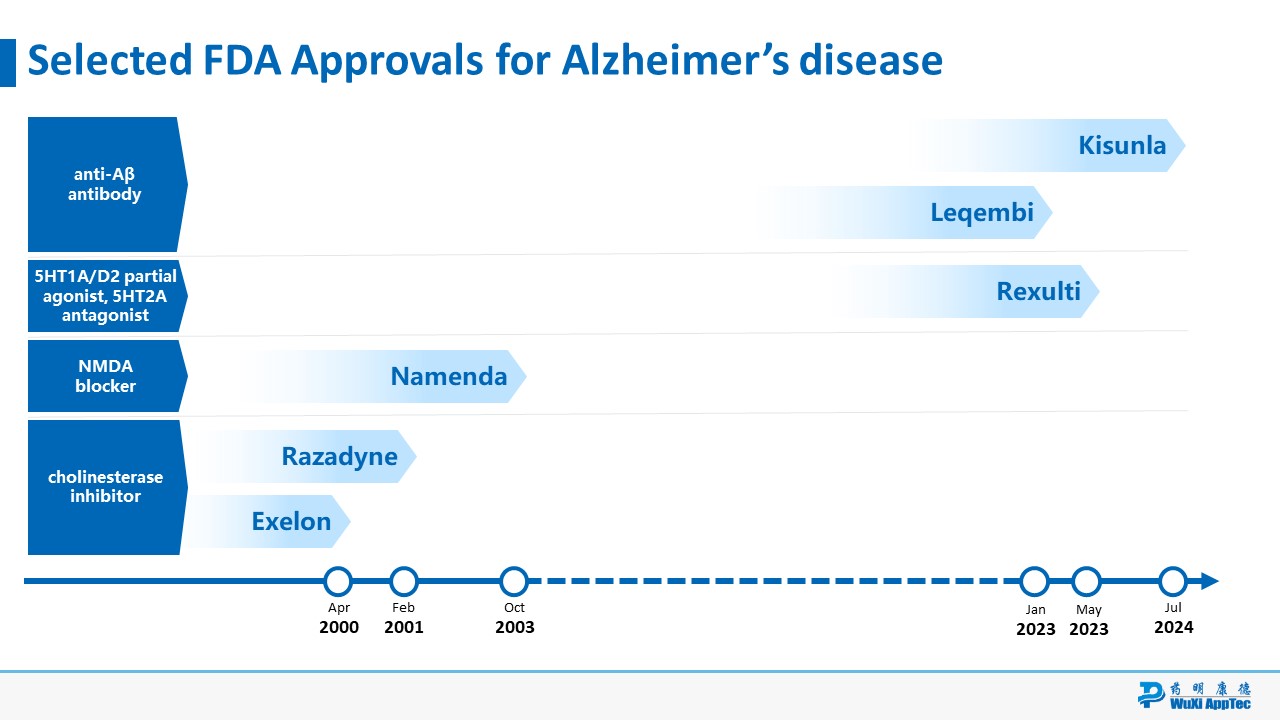
Memantine (Namenda), approved in 2003, introduced a new mechanism by targeting NMDA receptors to prevent excitotoxicity, a process that leads to neuronal damage and cognitive decline. Memantine, often used in combination with cholinesterase inhibitors, has been instrumental in treating moderate to severe stages of the disease.
The recent decade has seen a significant shift towards disease-modifying therapies. Lecanemab (Leqembi), which received approval in 2023, targets and reduces amyloid plaques in the brain, showing a statistically significant reduction in cognitive decline among patients with early-stage Alzheimer’s. Donanemab (Kisunla), approved in 2024, targets a specific form of amyloid-beta known as N3pG, offering the potential to slow disease progression in early-stage patients. Donanemab is also the first amyloid plaque-targeting therapy with evidence to support stopping therapy when amyloid plaques are removed, which can result in lower treatment costs and fewer infusions. These therapies represent a crucial advance, providing hope for altering the course of the disease rather than just managing symptoms.
Although these advancements are commendable, the journey is far from over. The current landscape of Alzheimer's research includes a variety of innovative therapeutic categories and mechanisms. These include tau-targeting therapies, anti-inflammatory approaches, neuroprotective agents, and synaptic enhancers. Researchers are also exploring gene therapy, stem cell therapy, and precision medicine to address the complex and multifaceted nature of Alzheimer's disease. Each of these approaches aims to not only alleviate symptoms but also modify the disease process itself, providing hope for more effective and lasting treatments.
The advancements in therapeutic options over the past decades are a testament to the power of collaboration, innovation, and sustained investment in research. Together, we are transforming the landscape of Alzheimer's treatment and offering hope to millions of patients and their families. Thank you to everyone who has contributed to making them possible. At WuXi AppTec, we remain deeply committed to advancing breakthroughs through our unique CRDMO service platform, driven by our vision that “every drug can be made and every disease can be treated”.
References:
1. FDA Grants Accelerated Approval for Alzheimer’s Disease Treatment. Retrieved August 29, 2024, from https://www.fda.gov/news-events/press-announcements/fda-grants-accelerated-approval-alzheimers-disease-treatment
2. FDA approves treatment for adults with Alzheimer’s disease. Retrieved August 29, 2024, from https://www.fda.gov/drugs/news-events-human-drugs/fda-approves-treatment-adults-alzheimers-disease
3. Alzheimer's Disease Fact Sheet. Retrieved August 29, 2024, from https://www.nia.nih.gov/health/alzheimers-and-dementia/alzheimers-disease-fact-sheet
4. Alzheimer’s Disease and Related Dementias. Retrieved August 29, 2024, from https://www.cdc.gov/aging/aginginfo/alzheimers.htm
5. Dementia. Retrieved August 29, 2024, from https://www.who.int/news-room/fact-sheets/detail/dementia
6. Dementia statistics. Retrieved August 29, 2024, from https://www.alzint.org/about/dementia-facts-figures/dementia-statistics
7. Alzheimer's Disease Facts and Figures. Retrieved August 29, 2024, from https://www.alz.org/alzheimers-dementia/facts-figures