


- About WXPress
- WXPress is your window into the world of WuXi AppTec and our global partners.
- Sitemap
- Events
- Contact
- Please reach out with any business inquires.
- communications@wuxiapptec.com
© 2026 WuXi AppTec. All Rights Reserved.Privacy Policy

Antimicrobial resistance (AMR) is emerging as a major global health crisis. A WHO study warns that by 2050, AMR could cause 10 million deaths annually, surpassing cancer as the leading cause of death. However, the pace of new drug development lags far behind the spread of resistant bacteria. During the 2022 WuXi Healthcare Forum, industry leaders shared their insights on the challenges and solutions to tackle AMR. Two years later, as we approach World Antimicrobial Resistance Awareness Week (November 18-24), it is time to revisit the landscape of AMR drugs development and recognize the urgent need for worldwide collaboration to combat this escalating health threat.
Overview of Current Development of AMR Drugs Pipelines
According to the WHO AMR report published this year, some advancements have been made in antimicrobial drug development recently. Between July 2017 and December 2023, 16 new antimicrobial drugs, including 13 traditional small-molecule drugs and three non-traditional antimicrobials, were approved by the regulatory authorities. Notably, two innovative drugs, cefiderocol and sulbactam-durlobactam, were specifically approved to address WHO-prioritized pathogens like carbapenem-resistant Acinetobacter baumannii (CRAB), marking a step forward in the fight against these dangerous infections. In addition, drugs like vaborbactam (in combination with meropenem) and lefamulin have met WHO’s innovation criteria, underscoring the industry's commitment to developing novel and effective treatments.
The current clinical antibacterial development pipeline is growing both in the number of drugs and the range of indications covered. As of December 31, 2023, there are 97 new antimicrobial drugs with new therapeutical entities targeting WHO bacterial priority pathogens, including M. tuberculosis, C. difficile, and H. pylori, currently in clinical development —a notable increase from 80 drugs in 2021. Encouragingly, the 2023 pipeline also shows an expansion to include new indications such as prosthetic joint infections (PJI), cystic fibrosis (CF)-related infections, H. pylori infections, and shigellosis, reflecting the industry's ongoing efforts to address more complex clinical syndromes through both traditional and non-traditional therapies.
The pharmaceutical and biotechnology industries continue to push boundaries in innovation. Of the 32 traditional antibiotics in development, 12 meet at least one of WHO's innovation criteria. Many of these drugs are in advanced stages of development; for instance, the topoisomerase inhibitors zoliflodacin and gepotidacin are currently in phase 3 trials, demonstrating promising progress. Non-traditional antimicrobials also have gained considerable momentum, with 30 new drugs targeting WHO priority pathogens actively being developed. These innovative solutions, such as bacteriophages, antibodies, anti-virulence agents, immunomodulators, and microbiome modulators, reflect the industry's commitment to combating AMR through cutting-edge mechanisms of action.
The current preclinical AMR drug pipeline reflects a globally coordinated effort and signifies a promising future for innovative medicine. As of December 31, 2023, there are 244 AMR drug candidates in preclinical development, with developers distributed across all six WHO regions, spanning 29 countries. A remarkable 38% of these candidates utilize non-traditional modalities, while 68% represent new chemical classes, and 55% feature novel mechanisms of action, underscoring the industry’s commitment to breakthrough therapies. Nearly half (48%) of the pipeline is designed to combat resistant phenotypes, illustrating a proactive response to the growing threat of resistance.
The Financing Landscape of the AMR Drugs Development
One of the biggest challenges in developing innovative drugs to combat AMR remains financing. However, we are witnessing encouraging progress, with total financing for companies developing AMR drugs rising steadily over the past three years.
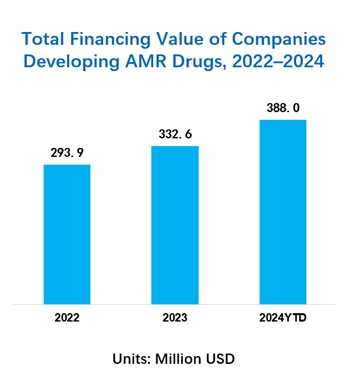
This upward trend in financing reflects a sustained commitment to tackling AMR, with consistent support year over year. This ongoing financial backing highlights the growing recognition of AMR as a critical health priority and suggests that even more companies may secure funding throughout the remainder of 2024, as investment in this essential area continues to expand.
Beyond direct financing, new business models are essential to drive AMR drug development. Key to stimulating more investment in AMR drug development is addressing market failure and making it more attractive to investors. "Pull incentives" can ensure that investors who fund the development of new antimicrobial drugs receive a return on their investment. Such incentives need to be globally coordinated, attractive enough, aligned with patient needs and the growing threat of resistant pathogens, and ensure global accessibility of the drugs. Additionally, these incentives should be decoupled from sales volume to prevent misuse and overuse, ensuring these drugs are used only when absolutely necessary. Investors should also work closely with policymakers to drive reforms that ensure antimicrobial drug development offers a stable return on investment.
Fighting AMR is a complex and long-term endeavor. While global collaboration has led to significant breakthroughs in AMR drug innovation, more effort is needed. Pharmaceutical companies and research institutions must continue to invest in developing novel drugs to meet the growing threat. Additionally, tackling AMR requires a holistic approach that includes improving diagnostic testing and creating transparent monitoring systems to ensure the rational distribution of antibiotics. A unified and sustained effort is crucial in addressing this global health crisis. As part of the global health ecosystem, WuXi AppTec is committed to advancing innovative medicines that meet the challenges of AMR, providing comprehensive support for drug discovery and development to accelerate solutions in this critical area.
Reference:
[1] 2023 Antibacterial agents in clinical and preclinical development: an overview and analysis. Retrieved October 22, 2024 from https://www.who.int/publications/i/item/9789240094000