

- About WXPress
- WXPress is your window into the world of WuXi AppTec and our global partners.
- Sitemap
- Events
- Contact
- Please reach out with any business inquires.
- communications@wuxiapptec.com
© 2026 WuXi AppTec. All Rights Reserved.Privacy Policy
Several years ago, WuXi STA, a subsidiary of WuXi AppTec, undertook a process optimization assignment for a client.
At the time, the client was advancing the development of an innovative drug candidate. A key chiral intermediate in the process required five steps using traditional chemical route, with an overall yield of approximately 40%. As the project moved toward later clinical stages, efficiency and cost constraints of this route became more evident, prompting a need for optimization.
WuXi STA’s biocatalysis team proposed an enzymatic route, condensing the original five-step synthesis into a single step, increasing the yield to 76%, and lowering costs by one-third.
The team did not stop there. The initial approach still required the coordinated action of three enzymes and two coenzymes, and operational complexity was an opportunity for improvement. To address this issue, the team leveraged high throughput directed evolution technology, targeting key regions and performing two rounds of directed evolution on the enzyme within a month.
Ultimately, the resulting reaction system was simplified to only one enzyme and one coenzyme. Synthesis time was reduced by two weeks, yield increased to 90%, and total cost was reduced by more than 70% compared to the original five-step chemical route – clearing a major hurdle for the drug's path toward commercialization.
From "five steps, 40% yield" to "one step, 90% yield", the leap was far more than a numerical – it accelerated the client's overall drug molecule development timeline. This case illustrates the capabilities of WuXi AppTec's biocatalysis platform and the value it has delivered to clients over the years.
The story begins earlier.
In the last century, the industry began exploring the use of enzymes to catalyze the synthesis of chemical compounds. With major advances in biocatalysis and directed evolution technology, by the 21st century this approach had become an important tool in pharmaceutical process development.
Enzymes can catalyze the synthesis of a wide range of both natural and unnatural compounds. They operate under mild conditions, typically in near-aqueous environments, avoiding the high temperatures and high pressures common in traditional chemical synthesis. As a result, biocatalysis is regarded as a cornerstone of green chemistry and is driving a shift toward more efficient and sustainable drug synthesis.
WuXi AppTec began systematically building its biocatalysis capabilities in 2012. The initial work was foundational: collecting natural and commercial enzymes to establish a screening enzyme library that would support active pharmaceutical ingredient (API) process development.
Back then, the team had no prior experience and no dedicated laboratory – and started from scratch. Buying enzymes from the market, the team stored them in a few refrigerators, and moved forward step by step.
Soon, the team successfully applied a biocatalysis process to a commercial manufacturing delivery — a crucial step from zero to one. As experience grew and expertise deepened, client demands grew steadily.
However, even as industry demand continued to rise, a fundamental bottleneck emerged: natural enzymes often exhibited poor activity when catalyzing the synthesis of unnatural compounds, severely limiting broader application.
With the increasing maturity of directed evolution technology, WuXi AppTec moved decisively. In 2016, it established a dedicated enzyme evolution laboratory, introducing high-throughput screening and semi-rational design to build in-house directed evolution capabilities. This marked a transition from passive enzyme screening to active enzyme engineering.
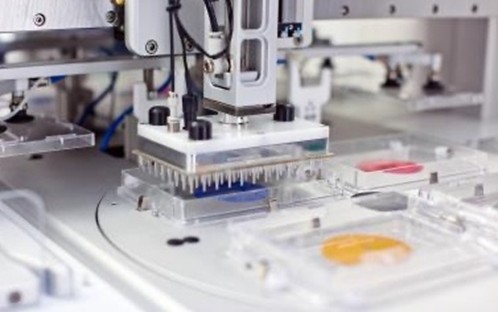
▲High throughput evolution robot
In 2017, the company's first 500 L pilot-scale fermenter came online, signaling the transition of enzyme fermentation preparation from laboratory scale to pilot scale.
To meet steadily increasing demand, the team expanded and upgraded enzyme production capacity, significantly strengthening large-scale manufacturing capabilities. Meanwhile, two directed evolution laboratories spanning nearly a thousand square meters were put into operation, further enhancing the ability to screen enzyme variants and evaluate function, providing solid support for the systematic application of biocatalysis technology.
After more than a decade of sustained investment, the platform has established comprehensive, systematic capabilities – an integrated platform covering enzyme screening, enzyme evolution, enzyme fermentation, and enzyme process development and scale-up.
In enzyme screening, the in-house enzyme library contains over 3,500 manufacturing-grade enzymes and more than 200,000 optimized variants, enabling rapid screening against target compounds. On average, the team can complete enzyme screening for a compound within two weeks.
If the initially screened enzyme requires further improvement in activity or selectivity, the platform can run more than 40 enzyme evolution projects in parallel. Using the high-throughput screening laboratory, the team quickly identifies enzyme variants with high selectivity and reaction efficiency for each project.
Once the target enzyme is identified, the platform possesses the capability for large-scale enzyme powder manufacturing. The fermentation facility seamlessly connects laboratory-scale to 10,000-liter reactors, with total fermentation capacity exceeding 20,000 liters. This allows for rapid delivery of enzymes at scales ranging from kilograms to metric tons, fulfilling project requirements at every stage.
For more than a decade, our platform has developed 650 enzyme-catalyzed processes and completed delivery of 440 manufacturing projects, including 20 projects in Phase III clinical or commercial stages. To date, the platform has delivered over 500 metric tons of key chiral intermediates and APIs.
In one early-stage project, a client faced a severe process bottleneck: the existing enzyme-catalyzed reaction system required a volume of 500V and an enzyme loading of 3X (relative to the substrate) yet achieved only 40% conversion. An alternative chemical synthesis route existed, but its complexity made kilogram-scale API manufacturing impractical.
Confronted with this impasse, the team addressed the root cause – engineering the enzyme itself. After five consecutive rounds of directed evolution, the team obtained a new enzyme with significantly improved performance. The new process reduced the reaction volume to 80V, and enzyme loading was reduced to 0.1X. Based on these results, the team successfully manufactured dozens of kilograms of the key chiral intermediate, providing robust support for the client's rapid clinical trial advancement.
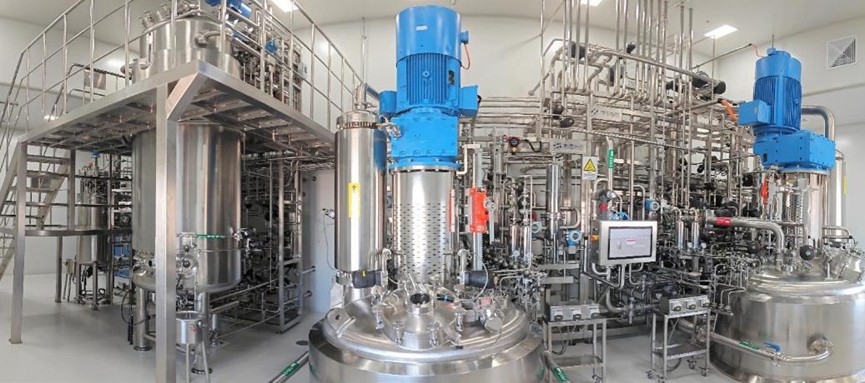
▲Fermentation Plant at WuXi AppTec
Today, WuXi AppTec's biocatalysis platform is being deployed to address synthesis challenges posed by diverse molecular modalities.
In recent years, peptide and oligonucleotide drugs have continuously expanded the frontiers of disease treatment, emerging as a new wave in drug innovation. Approximately 100 peptide drugs have been approved globally, with over 40 novel peptides approved by the FDA in the past decade alone. Meanwhile, the application scope of oligonucleotide drugs is expanding from rare diseases to broader therapeutic areas.
This wave presents new challenges for synthesis technology: longer sequences, more complex modifications, stricter quality control, and tighter delivery timelines. In response, WuXi AppTec's integrated biocatalysis platform has established targeted solutions.
In the peptide field, the team has been developing enzyme-catalyzed methods for various novel unnatural amino acids (UAAs) to optimize synthesis and reduce organic solvent usage and expedite manufacturing of UAAs and peptide drugs.
Take, for example, an early-stage peptide project where the traditional chemical synthesis route required over 30 steps, with a total yield below 1%. As the project entered the critical process performance qualification (PPQ) stage, overcoming this efficiency bottleneck became a priority.
A biocatalysis solution was proposed. Working closely with the client, the team systematically re-engineered the entire synthetic route and performed directed evolution on more than ten enzymes. The result: the number of synthetic steps was reduced by more than ten, and the overall yield increased by several dozen-fold, providing substantial support for the drug's large-scale manufacturing.
In the oligonucleotide field, the preparation of long-chain RNA has long been a major pain point in drug development, with traditional solid-phase synthesis facing challenges in both poor purity and low yield.
To address this, WuXi AppTec's biocatalysis team utilized an enzymatic ligation strategy to improve success rates in long RNA synthesis. They designed ligation sites based on RNA secondary structure, developed highly active ligases, and assembled multiple short RNA fragments into long chains. This approach addressed the key bottleneck in preparing long-chain RNA fragments. The team applied this process to a complex di siRNA–GalNAc conjugate, achieving enzymatic ligation efficiencies above 95%, crude product purity up to 98%, and a significantly improved final yield.
Today, the platform serves as one of the important accelerators for drug development of emerging modalities such as peptides and oligonucleotides, continuously enabling clients to overcome process development and manufacturing bottlenecks and improve efficiency. The synergy between biocatalysis and chemical synthesis is creating even greater enabling potential amid the wave of innovative molecules.
Meanwhile, as directed evolution technology increasingly integrates with other tools, the efficiency of enzyme engineering is expected to improve further, and the boundaries of application will continue to expand. This technology is expected to be applied to a broader range of chemical reactions in the future, supporting both drug development efficiency and the industry's progress toward greener and more sustainable practices. As one of WuXi AppTec's internal enabling platforms, biocatalysis represents a more efficient and greener synthetic pathway.
From laboratory research to commercial manufacturing, from screening a single enzyme molecule to stably delivering diverse fermentation products from kilograms to metric tons, the capabilities of WuXi AppTec's biocatalysis platform have grown steadily. Yet the founding purpose remains unchanged: to enable clients, accelerate project timelines, and help clients bring breakthrough therapies to patients faster.
Within WuXi AppTec's integrated CRDMO enabling platform, biocatalysis is a key component of its broader network of technology platforms. Its development reflects the company's ongoing capability building and iterative optimization across comprehensive technologies. It complements various other technical capabilities – such as flow chemistry, metal catalysis, crystallization and particle engineering among others – all of which together form a coordinated capability network. This network provides clients with comprehensive, multi-dimensional process development and manufacturing solutions.
Biocatalysis and flow chemistry, for example, are often considered as two pillars of green chemistry: biocatalysis enables reactions under mild, near-aqueous conditions, while flow chemistry improves efficiency and safety through continuous manufacturing. On WuXi AppTec's integrated platform, the synergistic application of these technologies aims to provide clients with full-chain support from laboratory process development to commercial manufacturing delivery.
The underlying logic of this technology network remains consistent: turning complex foundational technologies into reliable enabling services that support global innovators in accelerating new drug development. Clients don't need to master the computational logic of directed evolution or understand the parameter control of a fermenter. They just need to see a more efficient, robust, and economical synthetic solution.
The true value of enablement often lies in the unseen details: in round after round of variant screening, in the enzyme synthesized within fermenters, and in continuously optimized synthetic routes. Every on-time delivery, every process breakthrough – these may not appear in the headlines announcing a new drug’s approval, but they accumulate into the trust for the WuXi AppTec team and are embedded in therapies that reach patients faster.
Perhaps this is the true meaning of enabling: not standing in the spotlight, but helping the light reach those in need faster.