


- About WXPress
- WXPress is your window into the world of WuXi AppTec and our global partners.
- Sitemap
- Events
- Contact
- Please reach out with any business inquires.
- communications@wuxiapptec.com
© 2026 WuXi AppTec. All Rights Reserved.Privacy Policy

Over the past eight years, oligonucleotide and peptide drugs – collectively, TIDES – have grown from specialized technologies into mainstream drug development platforms. WuXi TIDES, the WuXi AppTec platform specializing in Contract Research, Development, and Manufacturing Organization (CRDMO) services for these molecules, has grown along with them.
“Eight years ago, we knew peptides and oligonucleotides had enormous potential, but we didn't fully anticipate how quickly they would move from some specialized technologies into the mainstream drug development platforms,” Yu Lu told BioWorld.
As senior vice president and head of WuXi TIDES and WuXi Chemistry Business Operations, she has helped build the TIDES-focused business. Today, WuXi TIDES supports more than 300 active oligonucleotide or peptide drug candidates across development stages, and its discovery team delivered more than 180,000 compounds in the past 12 months, according to Lu.
WuXi TIDES began building its research and development playbook in 2018. Since then, “we are applying and continuously improving this playbook across all these increasingly complex molecules, seeking ways to accelerate development without compromising quality.”
Both the oligonucleotide and peptide markets have grown enormously over that period, though they have done so from different starting points.
In 2018, oligonucleotides were a niche therapeutic class, albeit one with obvious potential. That year brought the approval of the first siRNA therapy in the form of Onpattro (patisiran, Alnylam Pharmaceuticals, Inc.), which was a milestone for the field.
“Oligonucleotide development was pretty much concentrated on rare diseases, genetic diseases, and a very small number of other validated targets,” Lu said.
When Onpattro, for example, was approved for treating polyneuropathy of hereditary transthyretin-mediated amyloidosis (hATTR-PN), the FDA estimated the prevalence of the disorder at between 5,000 and 10,000 people. Globally.
Today, Lu estimates that more than 25 oligonucleotide drugs are commercially available, while public data showed 350 in clinical development at the end of September this year.
Peptides as a therapeutic class have a much longer history – the first patient was treated with insulin in 1922, and solid-phase peptide synthesis (SPPS), which allowed fast and automated synthesis, was developed in the 1960s.
A 2019 review paper identified over 60 approved peptide drugs worldwide, and 150 peptides in active clinical development. But like oligonucleotides, their development was concentrated in a few applications. “Many of the innovators viewed peptides as very specialized options for some particular biological targets,” Lu said.
The success of GLP-1 agonists overturned that image. Collectively, the class showed that “peptide engineering can now deliver medicines with both clinical and commercial impact in some of the major chronic diseases,” she said. And oral semaglutide set an important example of how formulation and delivery innovation can expand the possibilities of a traditional injectable peptide.
As a result, there are more TIDES molecules, those molecules are more complex, and there are many more eligible patients who could benefit.
For example, the enormous success of GLP-1 agonist peptides led to a major manufacturing bottleneck for this drug class. More generally, Lu said, “there are nearly 100 approved peptide drugs worldwide, and more than 450 drug candidates that are in phase I to phase III clinical development stages. There are a lot more in the preclinical discovery stage.”
And peptides have grown in their complexity as well as their numbers.
“We have moved well beyond simply reproducing the natural peptides or natural peptide hormones,” Lu added. “Innovators are engineering peptide molecules with much improved stability, longer duration of action, more complex conjugation strategies, and much more ambitious delivery goals.”
For oligonucleotide therapeutics, “today the major focus is on extrahepatic delivery.” Reaching these tissues requires increasingly complex structures, chemical modifications, and conjugates. For example, peptide-conjugated phosphorodiamidate morpholino oligomers (PPMOs) and antibody–oligonucleotide conjugates (AOCs) have enabled the delivery of oligonucleotides to muscle tissue to treat disorders like Duchenne Muscular Dystrophy.
Developers are also pursuing more complex targeting strategies. Lu described di-siRNA, a dual-targeting siRNA that can target two distinct mRNA transcripts, functioning as an RNAi-based analogue to bispecific antibodies.
These molecules contain three strands: a long sense strand of more than 40 nucleotides—roughly twice the length of a typical siRNA—and two antisense strands. The additional coupling steps can lower yields and complicate synthesis and analytical control. “It’s a real challenge,” Lu said.
“The whole industry has become very good at designing some promising, very complex molecules, by using AI and some other advanced tools,” she added. “But the harder problem is turning these molecules into reproducible, scalable and affordable clinically useful medicines. So, there's a big gap from designing a molecule to delivering a medicine."
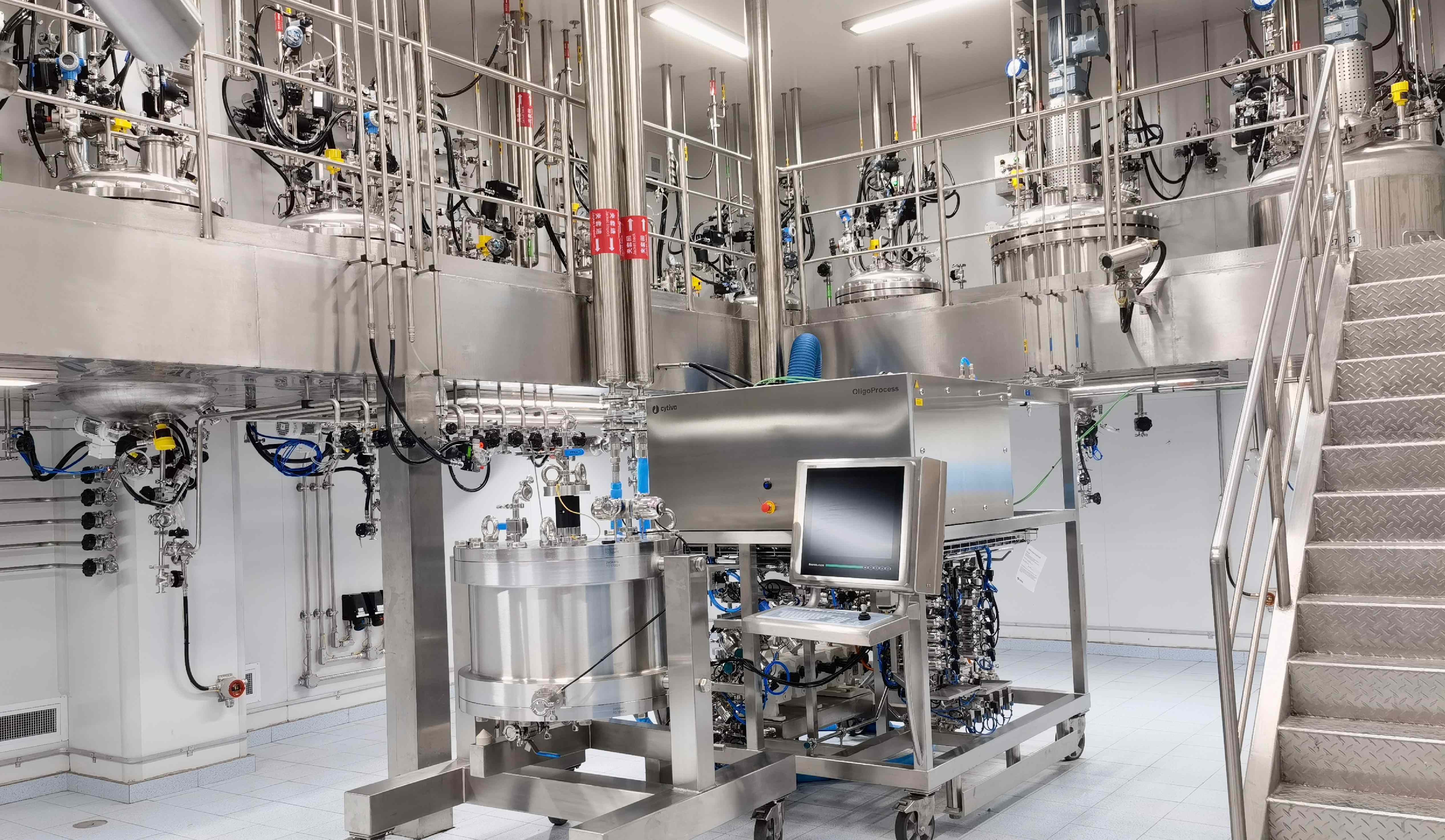
▲An oligonucleotide synthesis plant at WuXi AppTec’s Changzhou site (Image source: WuXi AppTec)
Closing that gap requires research, development and manufacturing capabilities to advance alongside molecular design. For WuXi TIDES, Lu said, that means anticipating what emerging programs will need and building the required capabilities accordingly. “As the science is moving ahead, our goal is to continuously build our platform before complexity becomes a bottleneck.”
WuXi TIDES’ approach combines deeper scientific expertise with closer coordination among teams. Its chemistry, formulation and analytical capabilities have matured while teams have become more closely integrated across development programs. “It's not one single breakthrough or improvement we made,” Lu said. That combination allows the company to work as a development partner as well as a service provider.
Development timelines have accelerated as the field and the science that underpins it have evolved. Preclinical development goes from hit finding to preclinical candidate (PCC) identification, to a drug substance/drug product (DS/DP) that is then optimized by the chemistry, manufacturing and controls (CMC) team to the final molecule that will be in the investigational new drug (IND) filing.
For a complex siRNA-GalNAc conjugate, the WuXi TIDES team collaborated with a client from the hit finding stage through preclinical PCC identification and the DS/DP to the IND-ready stage in 15 months. “About eight months from hit identification to PCC identification,” Lu said. “And another seven months from PCC to IND ready.”
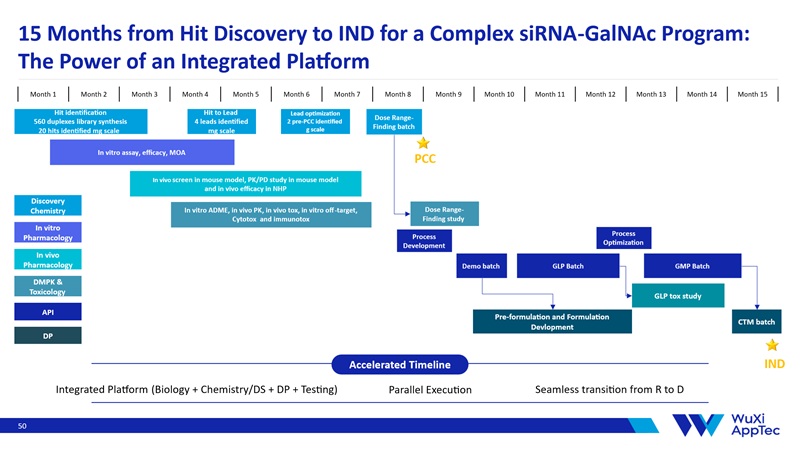
▲WuXi TIDES enables a complex siRNA–GalNAc (Hit → IND) in 15 Months (Image source: WuXi AppTec)
In addition, two to three years ago, a typical DS/DP integrated siRNA IND-CMC project took WuXi TIDES around 10 to 12 months to complete. “Today, our average for a similar project is 7 to 8 months,” Lu said.
This speed of development, Lu said, means that “you won't have time to say, ‘Oh, let me fix some of the CMC issues later on.’ Many of these issues need to be considered very early on. The lab synthesis doesn't automatically translate into a very robust clinical or a commercial manufacturing process.”
That, in turn, “requires our customer team and our WuXi TIDES team to be partnering very early on in the discovery phase so that we can select the right preclinical candidate and the right formulation for the downstream development.”
She added, “There's no single delivery solution for every molecule. The right approach depends on the payload, the target tissue, the mechanism of action, and your route of administration. WuXi TIDES’ strength lies in bringing all these capabilities together – oligo or peptide discovery, process, chemistry, the payload, the linker, ligand designs, complex conjugation strategies, and executing drug product formulation development and drug product manufacturing.”
Once a molecule has entered the clinical stage, efficient manufacturing becomes another potential bottleneck.
“One important lesson from the growth of the peptide therapeutics in the last few years is that because of the rapid surge of the market demand in peptide due to GLP-1 and other medicines, manufacturing capacity and process efficiency becomes a significant bottleneck for the industry.” The scale at which peptides were historically produced is no longer sufficient for that demand, Lu said, and the pace of change has exceeded many companies’ expectations.
WuXi TIDES has increased its solid-phase peptide synthesis capacity more than 20-fold in four years, from 6,000 liters in 2022 to currently more than 130,000 liters. It has also expanded its global supply chain to support production of large quantities of peptides.
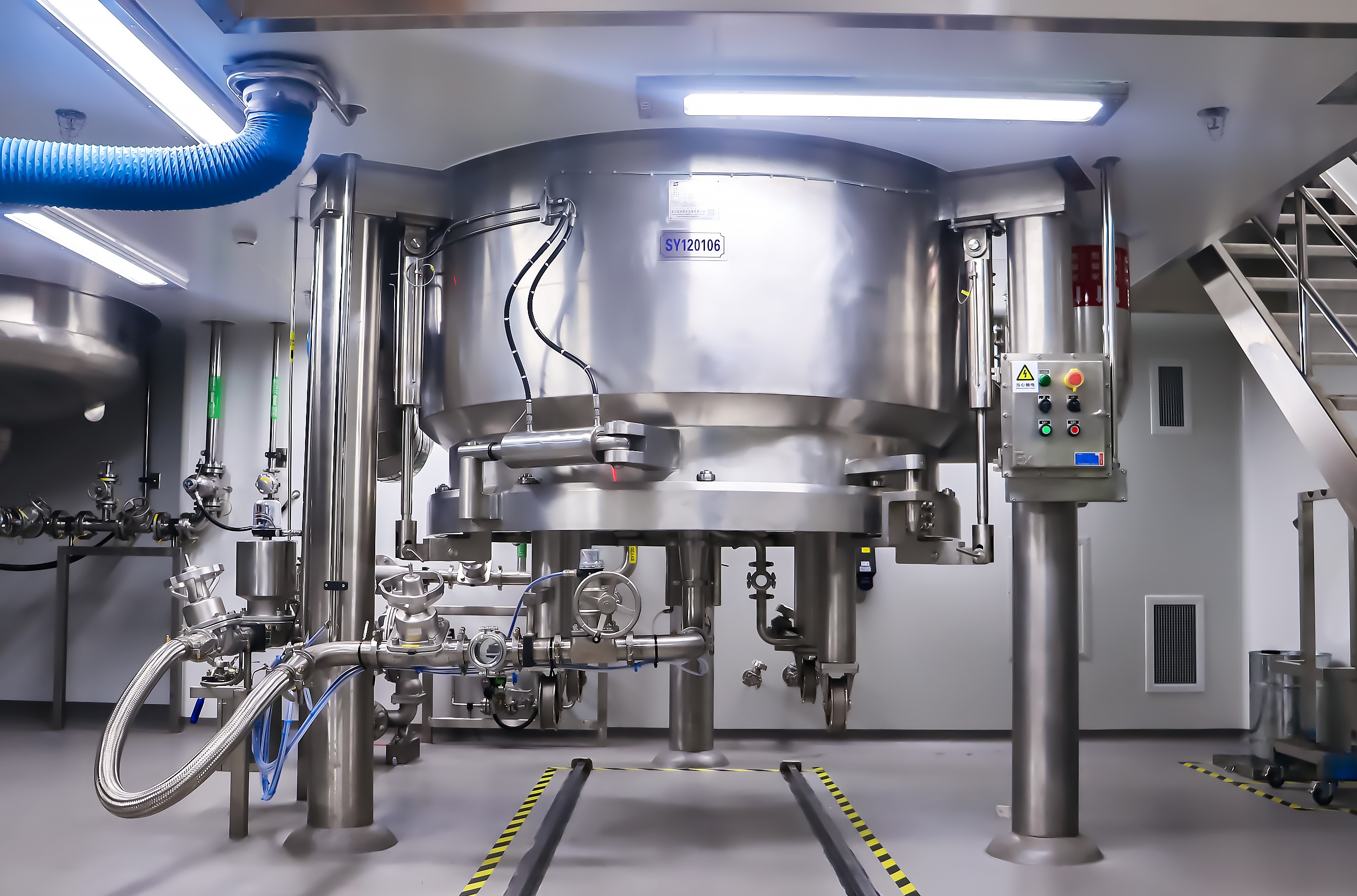
▲A 5,000 L peptide synthesizer (Image source: WuXi AppTec)
At the same time, the company has worked to reduce the environmental footprint of that manufacturing.
“We realize that if we just repeat the old technologies, it doesn't necessarily solve the underlying economics and environmental footprint that is notorious for peptide manufacturing,” Lu said. As WuXi TIDES has ramped up its manufacturing capacity, “through the strong partnership with our clients, we've also implemented a green chemistry mindset.”
Those innovations have paid off in a highly efficient manufacturing process.
Peptide manufacturing is notorious for high process mass intensity (PMI), which is the amount of starting materials needed to make one kilo of peptide. “The PMI for traditional peptide synthesis is much, much higher than, for example, small molecules,” Lu explained.
A 2024 review paper in the The Journal of Organic Chemistry estimated that the PMI for SPPS is about 13,000 for commercial peptide APIs. (The authors dryly noted that this number “does not compare favorably with other modalities.” Small molecules have a median PMI of 168-308. Even other biologics do better than peptides, with a PMI of about 8,300.)
In the same year, WuXi TIDES’ internal benchmark was 3,659 – less than 30% of the industry benchmark reported in the The Journal of Organic Chemistry. In the year of 2025, WuXi TIDES further reduced its commercial API PMI to 3,303. These results reflect WuXi TIDES’ differentiated capabilities across the full peptide API value chain: deep expertise in upstream and downstream process development, seamless translation from lab to manufacturing, and disciplined, ongoing optimization of plant execution.
As the TIDES field expands, its progress depends on turning increasingly sophisticated molecules into medicines that can be produced reliably, at scale and at a sustainable cost. Earlier collaboration, shorter development timelines and more efficient manufacturing help close that gap.
For Lu, the meaning of that progress becomes tangible when customers call or email to mark a clinical or commercial milestone or share a patient’s story during a visit.
“What excites me most is when something we worked on stops being a molecule on paper and becomes a medicine that is being tested or treating a patient,” she said.
Those moments connect the daily work of discovery, development and manufacturing to its ultimate purpose: “Because there's a patient at the other end of every program we work on, every molecule we work on.”