


- About WXPress
- WXPress is your window into the world of WuXi AppTec and our global partners.
- Sitemap
- Events
- Contact
- Please reach out with any business inquires.
- communications@wuxiapptec.com
© 2026 WuXi AppTec. All Rights Reserved.Privacy Policy
On an autumn day of 2025, WuXi AppTec’s Research Chemistry Services (RCS) received an email from a customer: they needed to design and synthesize a bioactive target molecule but were stuck at a key intermediate step, and using conventional routes was hard to move forward.
Based on years of collaboration and trust, they asked the RCS team, “We heard you have an electrochemistry platform. Could you try to synthesize this molecule?”
The project team traced the synthesis from the intermediate to the target molecule and counted roughly 19–20 additional steps. Based on the expected yields for each step, the intermediate would require at least several tens of grams to sustain downstream work. For many simple syntheses, producing tens of grams is trivial, but for this class of complex molecules, it presents a high level of difficulty.
The team responded quickly. WuXi AppTec’s in-house electrochemistry team had previously accumulated relevant knowledge, experience, and a complete set of equipment. The challenge was significant: the intermediate previously synthesized in-house bore no substituents, whereas the customer’s target intermediate was expected to carry a specific substituent that notably altered reactivity.
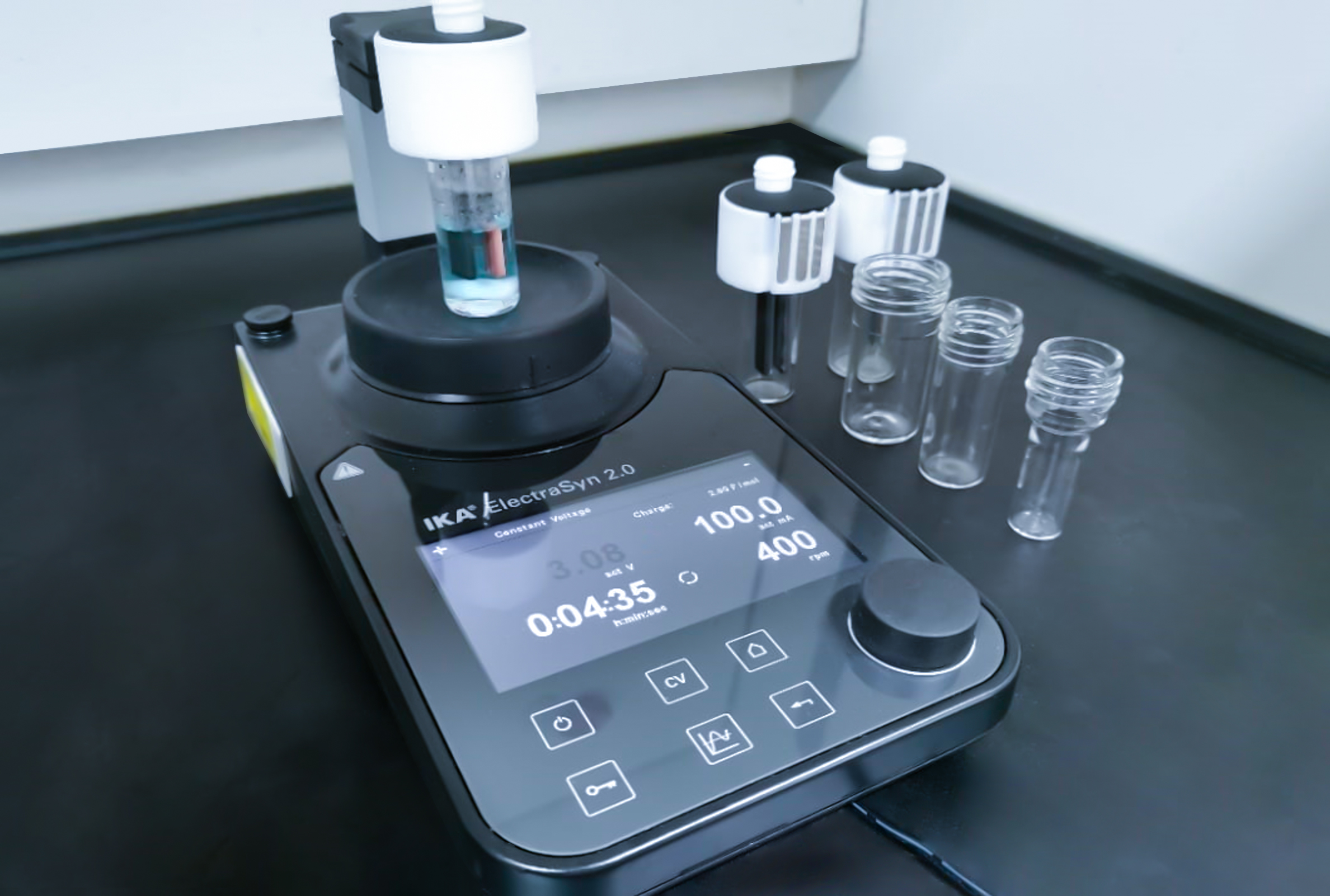
The electrochemistry team first followed protocols guided by existing knowledge, but as expected, the reactions failed to produce the desired product. Rather than retreat, they decided to open a new path. Building on prior knowledge, they launched an intensive experimental campaign and found that small deviations in parameters led to much different outcomes. They methodically adjusted parameters including electrolyte equivalents and concentrations, and screened a variety of electrodes. After several days of iterative trial and error, optimized conditions emerged.
Working in close coordination, the electrochemistry team achieved rapid progression within one week: they progressed from virtually no reaction to lab-scale condition screening, succeeded in pilot-scale synthesis, and scaled up to deliver tens of grams of production—followed by downstream work on purification, separation, and analysis—just in one continuous effort. The unexpectedly rapid timeline and production delighted the customer. The following week, the customer placed a second tens-of-grams scale requirement, and further scale-up batches followed. With the key intermediate secured, the final target molecule was successfully synthesized and passed preliminary testing.
Previously, the customer had seen WuXi AppTec’s capabilities in multiple synthetic technologies including flow chemistry, metal catalysis, and photochemistry, but this was their first direct collaboration on electrochemistry. During this project they witnessed the new platform’s effectiveness and gained confidence in the company’s capabilities.
In the process of tackling the above challenge, organic electrochemical synthesis is the applied branch of electrochemistry used by the team.
Although the field traces back to early pioneers—Faraday and Kolbe in the 19th century—and later theoretical advances such as Marcus’s electron-transfer theory, progress was limited by electrode materials and equipment for many decades. As a result, electrochemistry lagged behind photocatalysis and metal catalysis.
Around 2017, driven by sustainability and green-chemistry goals and improvements in electrode materials, catalysts, and reactors, the field began to revive. By 2020, the number of publications in synthetic electrochemistry had doubled compared with 2010. In the same year, Phil S. Baran’s group published an important paper, which served as a “user guide” for organic electrochemical synthesis and fueled the academic community’s enthusiasm for synthetic electrochemistry. Industry responded as well: a 2022 survey found that 15 of 17 large pharmaceutical companies were actively applying or exploring electrochemical methods.
In fact, before this niche tool found its moment, WuXi AppTec had applied electrochemistry in limited contexts—classical Shono oxidation—for over a decade. Based on insights into industry trends, the company increased investment in the electrochemistry platform in 2022.
“Whether for traditional chemistry or for newer methods such as photochemistry, electrochemistry serves as a strong complement. By building related capabilities early, we can begin to explore its advantages and potential in advance; when customer demands arise, we will be better prepared, since we have more tools to choose from. If we wait until customers demand it before we start building, it will place ourselves at a reactive position,” said the head of the electrochemistry platform, whose remarks reveal WuXi AppTec’s strategic vision and sense of responsibility in applying various innovative technologies.
In 2022, the electrochemistry team quickly established equipment, workflows, including adoption of internationally used electrochemical reactors, and developed an in-house capability for parameter screening, thereby enabling partners in condition screening and scale‑up. That year the team carried out extensive research efforts, reproduced literature reactions and explored new transformations, expanded their practical operating experience in electrochemistry and cross-platform collaboration skills. Within that year, the team had delivered multiple client projects by leveraging this new technology.
By 2025—three years later—the number of electrochemical reactions the team handled had grown significantly. The platform exhibited a distinct advantage in complex synthesis challenges that other techniques struggled with. For example, in targeted protein degradation (TPD) molecule synthesis, applying electrochemistry to reductive homocoupling of alkyl and aryl halides produced high success rates and made tens-of-grams syntheses routine. The platform supported dozens of projects annually for tricky reactions between highly sterically hindered BCP-derived NHP esters and aryl halides, and it showed particular promise for coupling reactions of sterically hindered, strained-ring NHP esters, where photocatalysis methods sometimes fail. Each year, it can "rescue" dozens of project molecules that stalled under photochemistry approaches.
Electrochemistry is noted by industry observers as a highly effective yet easily deployable approach, capable of driving challenging reactions with simple apparatus. Take one customer project, for example, the team used inexpensive and readily available dicarboxylic acids and a relatively lower-cost RVC (reticulated vitreous carbon) electrode instead of costly platinum. Through electrochemical decarboxylative coupling, they built a C(sp3)–C(sp3) bond to synthesize a non-natural β‑amino acid efficiently, streamlining the original 7-step synthesis route into just one step, and raising yield from 21% to 74% for rapid milligram‑scale preparation.
Image Source: 123RF
As successful cases accumulated, a growing number of electrochemistry-driven collaborative initiatives are pouring in. Today, the platform reliably delivers hundreds of molecules per year. WuXi AppTec maintains electrochemistry labs and scientists across multiple sites and has developed dozens of electrochemical reaction types. Individual reactions are operable from sub-100 mg scales up to over 200 g.
The electrochemistry platform forms part of WuXi AppTec’s CRDMO “synthesis toolbox” alongside flow chemistry, metal catalysis, and photochemistry. These technologies are complementary, and the “toolbox” approach broadens synthetic options for partners.
For example, electrochemistry and photochemistry both drive electron flow to accomplish oxidation–reduction transformations. The two are highly complementary, while each excels in different niches. Photochemistry is a well-developed area and offers a wider range of reaction types; electrochemistry, however, has advantages in specific reactions: it is operationally simple (often avoiding rigorous anhydrous or oxygen‑free conditions); uses mild conditions that can eliminate group-protecting steps and shorten sequences, thus significantly improving yields; and typically produces fewer impurities, easing purification.
For constructing C(sp2)–C(sp3) and C(sp3)–C(sp3) bonds, photochemistry is often the primary tool while electrochemistry provides powerful support. Some molecules that give low yields with photocatalysis methods show significant yield improvements under electrochemical approaches, enabling successful delivery for downstream biological testing. For example, high-sp3 fragments are increasingly linked to clinical success, so efficient methods for building C(sp3)–C(sp3) bonds are highly demanded; recently developed electrochemical decarboxylative coupling (rAP‑Kolbe/dDCC) is one such innovation that accesses valuable modules difficult to obtain conventionally.
Electrochemistry can also supplement photochemistry for sterically hindered systems, resolving “dark” reaction pockets where photochemistry‑driven methods are ineffective. It aids in challenging cross-electrophile coupling for sterically hindered C(sp²)–C(sp³) bond formation, NHP ester couplings, and synthesis of sterically hindered alkyl ethers. Additionally, electrochemical methods can complement metal catalysis in constructing C–N and C–O bonds, and they offer milder solutions for reactions that would otherwise require pressure, hazardous reagents, or gases.
The electrochemistry platform leader notes that when synthesis encounters a barrier, the team first applies mature methods and then, if needed, decisively switches to electrochemistry or runs multiple approaches in parallel to give customers more scalable options. This “toolbox” integration makes many complex syntheses feasible and helps projects progress to later stages, especially for small biotech customers who must meet tight timelines with limited opportunity for trial and error. For such customers, a comprehensive, reliable capability enables them to rescue molecules that conventional synthesis leaves behind, thus de-risking and better advancing early-stage innovation.
WuXi AppTec’s electrochemistry platform development mirrors the company’s broader chemical capability: methodical, cumulative work that builds an integrated CRDMO enabling platform.

Image Source: 123RF
Nowadays, as new modalities grow larger and more complex, synthesis becomes harder and routes lengthen; for a broadly capable integrated end-to-end CRDMO platform, these trends represent an opportunity. WuXi AppTec believes that early investment and continuous refinement of technical capabilities are essential to building a comprehensive integrated “technology toolbox” that enables global innovators.
In the future, WuXi AppTec will continue to align with scientific progress, respond to evolving customer needs, keep pace with advances in molecular complexity, and continuously scale capabilities and infrastructure, to enable global innovators in overcoming new drug development bottlenecks, and support their efforts to bring innovative treatments from the lab to patients.