

- About WXPress
- WXPress is your window into the world of WuXi AppTec and our global partners.
- Sitemap
- Events
- Contact
- Please reach out with any business inquires.
- communications@wuxiapptec.com
© 2026 WuXi AppTec. All Rights Reserved.Privacy Policy
From the “accidental birth” of aspirin to recent advances against previously “undruggable” targets, covalent drugs have evolved for over a century. As of 2025, over 50 covalent drugs have been approved, demonstrating unique value in oncology, infectious diseases, neurological disorders and beyond. It has remained a central challenge to discover covalent molecules more efficiently and precisely. Leveraging its integrated, end-to-end CRDMO platform, WuXi AppTec is committed to providing global partners with integrated solutions for covalent drug discovery and development. This article highlights WuXi AppTec’s capabilities and practices in covalent drug discovery.
A Century-Long Evolution of Covalent Drugs
In 1899, a compound known as acetylsalicylic acid was officially launched under the name aspirin to relieve pain and inflammation. This milestone in modern pharmaceutical history also inadvertently marked the beginning of covalent drugs.
Traditional small-molecule drugs rely on non-covalent interactions with target proteins. Such binding resembles a transient “handshake”, once the drug is metabolized and cleared, its therapeutic effect dissipates.
Covalent drugs, however, offer a different paradigm.
They contain electrophiles that form covalent bonds with specific amino acid residues on target proteins. This process can be likened to inserting a key into a lock, enabling a “docking & locking” mechanism that prolongs the duration of action.
While aspirin has benefited countless patients, its mechanism of action was not elucidated until decades later. In the 1970s, scientists discovered that aspirin forms a covalent bond with a serine residue in cyclooxygenase via its acetyl electrophile. This finding not only explained its pharmacological activity but also helped define the concept of covalent inhibition.
Such stories are far from rare. Classic antibiotics such as penicillins, cephalosporins and fosfomycin achieved clinical success long before their covalent mechanisms were fully understood.
Due to concerns about potential off-target effects, covalent drugs were once sidelined in drug development. However, as these “accidentally discovered” molecules continued to prove their clinical value, perceptions began to shift.
Entering the 21st century, rational drug design enabled the emergence of covalent inhibitors such as the BTK inhibitor ibrutinib and the EGFR inhibitor afatinib. In recent years, covalent drug discovery has entered a new phase. Through systematic screening of ligands that form covalent bonds with specific residues, researchers have unlocked previously “undruggable” targets, leading to the development of KRAS G12C inhibitors such as sotorasib and adagrasib.
To date, more than 50 covalent drugs have been approved by the FDA. Their high potency, prolonged duration of action, and ability to expand the target landscape have made covalent mechanisms a key direction in modern drug discovery.
The rapid progress of covalent drugs has also raised the bar for screening technologies. From high-throughput screening of covalent libraries to fragment-based approaches and DNA-encoded libraries (DEL), emerging technologies are continuously opening new avenues for covalent drug discovery, ushering in a new chapter in this century-long journey.
Covalent DEL Expands the Landscape of Covalent Screening
In the course of covalent drug discovery, WuXi Biology (a business unit of WuXi AppTec) once encountered a notable challenge: designing covalent inhibitors for the pro-oncogenic glycolytic enzyme PGAM1. The difficulty lay in the absence of cysteine within the enzyme’s active site.
Cysteine is the most commonly targeted reactive residue for covalent drugs due to the high reactivity of its thiol group, which readily forms stable covalent bonds with electrophiles. However, this strategy has clear limitations. Cysteine accounts for only about 2% of residues in the human proteome, leaving many potential targets without accessible reactive sites. PGAM1 is a representative example.
The progress came from WuXi Biology’s continuously evolving DEL platform.
In a DEL system, each compound is tagged with a unique DNA tag. When millions—or even billions—of tagged compounds are incubated with a target protein, researchers can rapidly identify high-affinity hits by decoding the tags, dramatically improving screening efficiency.
As early as 2018, when DEL remained a technically demanding approach mastered by only a few laboratories, WuXi Biology initiated the construction of its DEL platform with the goal of making it broadly accessible for all researchers. Starting from scratch, the first DEL offering took shape within months, and the platform welcomed its first client after a year.
Today, with the launch of products such as DELopen, DELight and DELpro, the DEL platform has become a cornerstone of WuXi AppTec’s drug discovery engine, enabling hundreds of screening campaigns annually across chemical spaces encompassing billions of compounds.
In the field of covalent drug discovery, WuXi Biology established its covalent DEL (cDEL) capabilities years ago. In 2023, with the expansion of its covalent compound libraries, the cDEL platform further evolved into a comprehensive system, supporting both reversible and irreversible covalent drug discovery.
For example, in irreversible covalent discovery, the DELink Pro platform covers 1.6 billion compounds and 184 specifically designed covalent electrophiles, offering customizable, one-stop solutions. In the reversible covalent space, the platform supports screening of over 400 million compounds incorporating 39 classes of electrophiles.
Notably, the platform is no longer limited to cysteine-targeting strategies. It has expanded screening to multiple amino acid residues, including lysine, serine and tyrosine. The introduction of novel electrophiles also enhances specificity while reducing off-target risks.
In the PGAM1 project, leveraging this integrated capability, WuXi Biology utilized both irreversible and reversible cDEL technologies to identify and validate a novel type of tyrosine-targeting inhibitors. Thanks to the diversity of electrophiles in the cDEL library, these inhibitors incorporate previously unexplored, non-classical electrophile structures.
As this case illustrates, the “explorable space” for covalent drug discovery is being systematically expanded through cDEL.
New Advances: Systematic Evaluation of cDEL Electrophiles
Enhancing cDEL capabilities requires not only scale expansion but also methodological refinement. In a recent study published in Helvetica Chimica Acta, WuXi Biology’s team collaborated with ETH Zurich to systematically evaluate the applicability of covalent DEL electrophiles.

The study addressed key challenges in cDEL related to reactivity and stability. Highly reactive electrophiles may compromise selectivity, while stability can vary significantly across different electrophile types. Without systematic evaluation, these factors may constrain the reliability of screening outcomes.
To this end, the research team selected 59 representative electrophiles spanning eight structural classes. Six classes were designed to form irreversible covalent bonds, including aryl halides, alkenes, alkynes and beyond, while two classes—aldehydes and nitriles—tended to form reversible covalent bonds.
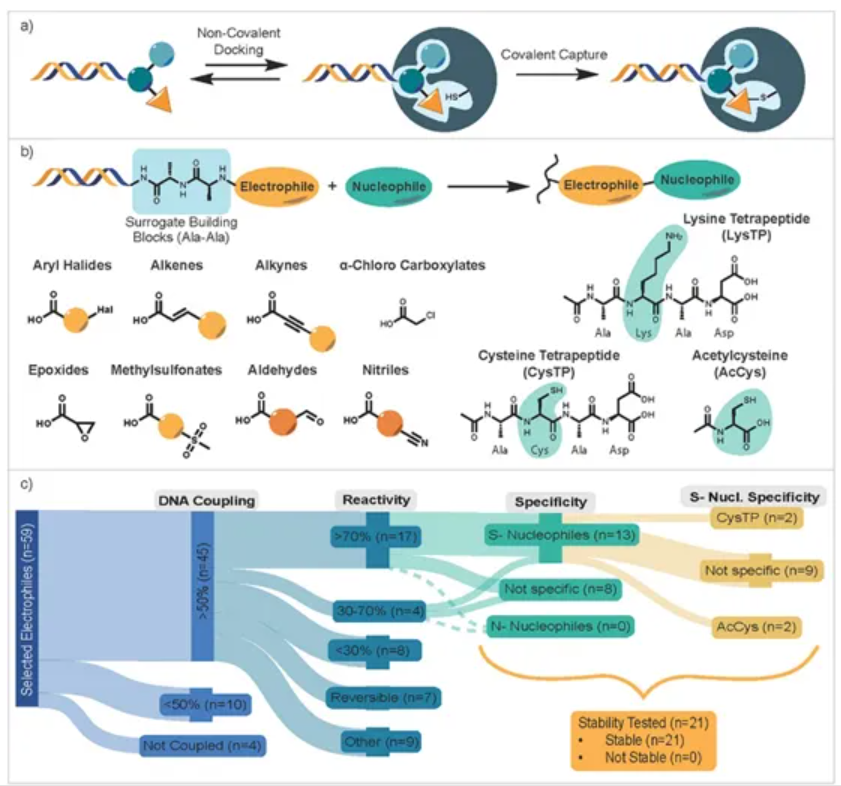
▲The study systematically evaluated the suitability of 59 electrophilic warheads for DEL applications.
Under conditions simulating real DEL construction workflows, the team first evaluated the coupling efficiency of each electrophile. Of the 59 candidates, 45 achieved a coupling yield above 50%, demonstrating ideal DEL compatibility.
Building on this, the team further assessed the reactivity and selectivity of these 45 electrophiles toward cysteine and lysine residues, as well as key parameters such as reaction kinetics and stability.
Ultimately, 21 electrophiles were identified that combined high coupling yield with strong reactivity, all of which also demonstrated high stability in subsequent evaluations. Notably, reversible electrophiles failed to maintain stability under the tested conditions, indicating that additional chemical steps may be required to improve their stability for future applications.
This study provides a systematic assessment of chemically diverse electrophiles within the cDEL framework and offers valuable guidance for the rational design of future covalent DEL libraries.
Building an Integrated Engine for Covalent Drug Discovery
cDEL does not operate in isolation. Within WuXi Biology’s covalent drug discovery platform, cDEL is deeply integrated with covalent fragment-based drug discovery (cFBDD) and covalent high-throughput screening (cHTS), forming a synergistic and complementary discovery engine.
The cHTS platform, built on large-scale covalent compound libraries, serves as an efficient hit identification engine. Its library comprises approximately 69,000 molecules featuring more than 50 distinct electrophile chemotypes. The library is purpose-built to target nine different amino acid residues, expanding screening beyond single-site approaches to broader protein space. The platform also offers “direct to biology” (D2B) solutions, providing end-to-end support from hit discovery to hit-to-lead optimization.
Meanwhile, WuXi AppTec’s cFBDD platform starts from smaller molecular fragments, offering another efficient pathway for covalent drug discovery. Based on a library of over 2,600 structurally diverse fragments, the platform incorporates electrophiles to rapidly identify covalent binders that serve as starting points for optimization. This strategy is particularly well-suited for structurally complex or traditionally “undruggable” targets.
Over more than a century, covalent drugs have evolved from serendipitous discoveries to rationally designed therapeutics, driven by continuous advances in screening technologies.
Nowadays, WuXi AppTec’s integrated platforms, including cDEL, cHTS, and cFBDD, work in concert to deliver systematic solutions for clients, ushering covalent drug discovery into a more systematic era.
Leveraging its end-to-end, integrated CRDMO platform, WuXi AppTec is committed to accelerating the development of breakthrough therapies, enabling partners translate innovation into solutions that benefit patients worldwide, and advancing its vision of “every drug can be made, and every disease can be treated.”