


- About WXPress
- WXPress is your window into the world of WuXi AppTec and our global partners.
- Sitemap
- Events
- Contact
- Please reach out with any business inquires.
- communications@wuxiapptec.com
© 2026 WuXi AppTec. All Rights Reserved.Privacy Policy
At the American Association for Cancer Research (AACR) Annual Meeting 2026, targeted protein degradation (TPD) therapies were among the most prominent areas of focus. In particular, the expansion from traditional E3 ligases such as CRBN and VHL to a broader range of novel ligases has emerged as a noteworthy trend. In this field, the WuXi Biology team of WuXi AppTec presented two research updates via posters at the conference.
In one of these studies, WuXi Biology constructed a novel molecular glue library and identified over 100 hit compounds, including CRBN-independent candidates. This work provides a new path for the development of non-CRBN molecular glues and next-generation TPD strategies.
In the other study, the team leveraged DEL screening to explore novel E3 ligases and constructed a series of proteolysis-targeting chimeras targeting the protein BRD4, demonstrating the value of DEL technology in the discovery of novel E3 ligases and the development of TPD therapies.
Why is the development of novel E3 ligases so critical? The answer lies in the mechanism of action of TPD molecules.
TPD therapies, represented by proteolysis-targeting chimeras and molecular glues, harness the ubiquitin-mediated protein degradation system within the human body to achieve selective degradation of target proteins.
The key enzymes recruited by these TPD molecules are E3 ligases. In the ubiquitination process, E3 ligases are responsible for recognizing substrate proteins and tagging them with ubiquitin, effectively marking them for degradation. As such, E3 ligases largely determine the selectivity and efficiency of protein degradation.
Humans encode more than 600 E3 ligases, yet the vast majority lack known, tractable ligands. Currently, only a few traditional E3 ligases, such as CRBN and VHL, are widely used in TPD drug development. This not only limits the expansion of chemical space but may also introduce risks of drug resistance.
Therefore, systematically exploring non-traditional E3 ligases and discovering corresponding small-molecule ligands has become a key challenge for the TPD field.
To support TPD drug discovery, WuXi Biology has built a systematic, integrated discovery platform covering target validation, molecule discovery, and functional mechanism characterization. The platform is designed to address the complex biological challenges associated with bifunctional degraders, molecular glues and other therapeutics in early-stage drug discovery.
The platform supports multiple stages of research in the TPD field, including hit finding, hit triage, and candidate selection. Its screening capabilities integrate multiple advanced ligand discovery strategies, including DNA-encoded library (DEL) screening, fragment-based approaches, affinity selection mass spectrometry (ASMS), and virtual screening, enabling efficient identification of both target protein ligands and E3 ligase ligands. In addition, it supports the design and optimization of novel linkers and complex bifunctional molecules.
Taking the poster on discovering novel E3 ligases via DEL screening as an example, the research team utilized DEL technology within the screening platform to conduct systematic affinity selection and evaluation across a chemical space of more than 40 billion compounds, across 30 candidate E3 ligases.
Through this process, a candidate protein named GID4 stood out.
GID4 is a substrate-recognition subunit of the CTLH E3 ligase complex, responsible for recognizing and recruiting target proteins for degradation. Previous studies have shown that GID4 can mediate the degradation of recruited substrates, highlighting its potential as an E3 ligase component for proteolysis-targeting chimeras.
Through DEL screening of more than 40 billion compounds, the team identified three hit series with varying affinities for GID4. However, the initial hits were characterized by high molecular weight and low ligand efficiency, limiting their potential as ligands for TPD molecule development.
To address these challenges, the team first applied systematic truncation and fragmentation of the initial hits, analyzing binding affinity alongside ligand efficiency metrics to define key pharmacophoric features. Building on these fragments, they then further refined the structures, ultimately identifying a set of promising GID4 ligands with molecular weights below 400 and significantly improved binding affinity and ligand efficiency.
To validate whether these GID4 ligands could be developed into TPD molecules, the team conjugated one optimized GID4 ligand to a BRD4-binding moiety to rapidly construct proteolysis-targeting chimeras. These molecules induced ternary complex formation and successfully degraded the target protein BRD4.
Following the initial validation, further exploration was needed to optimize the combination of GID4 ligands, BRD4 ligands, and linker designs. However, optimization of proteolysis-targeting chimeras often lacks rational design and is resource-intensive in traditional drug discovery workflows.
At this stage, WuXi AppTec’s Direct-to-Biology (D2B) platform became a critical engine that accelerated the development of targeted protein degradation molecules. By enabling nanomole-scale, high-throughput chemical synthesis directly in microplates, followed immediately by biological testing, the D2B approach allows for rapid design, synthesis, testing, and preliminary analysis of thousands of compounds within just 2-3 weeks, while significantly reducing material and reagent consumption.
Leveraging this strategy, the team started with nearly ten internally optimized, high-quality GID4 ligands and systematically explored linker diversity. Through combinatorial chemistry design, they efficiently mapped structure–activity relationships (SAR) and identified optimal combinations of ligands and linkers.
Using the D2B platform, the team synthesized and screened hundreds of derivatives within two weeks, rapidly identifying several GID4-recruiting proteolysis-targeting chimeras with superior degradation activity. These molecules demonstrated a tenfold improvement in BRD4 degradation activity compared with the initial hits, laying a solid foundation for further development.
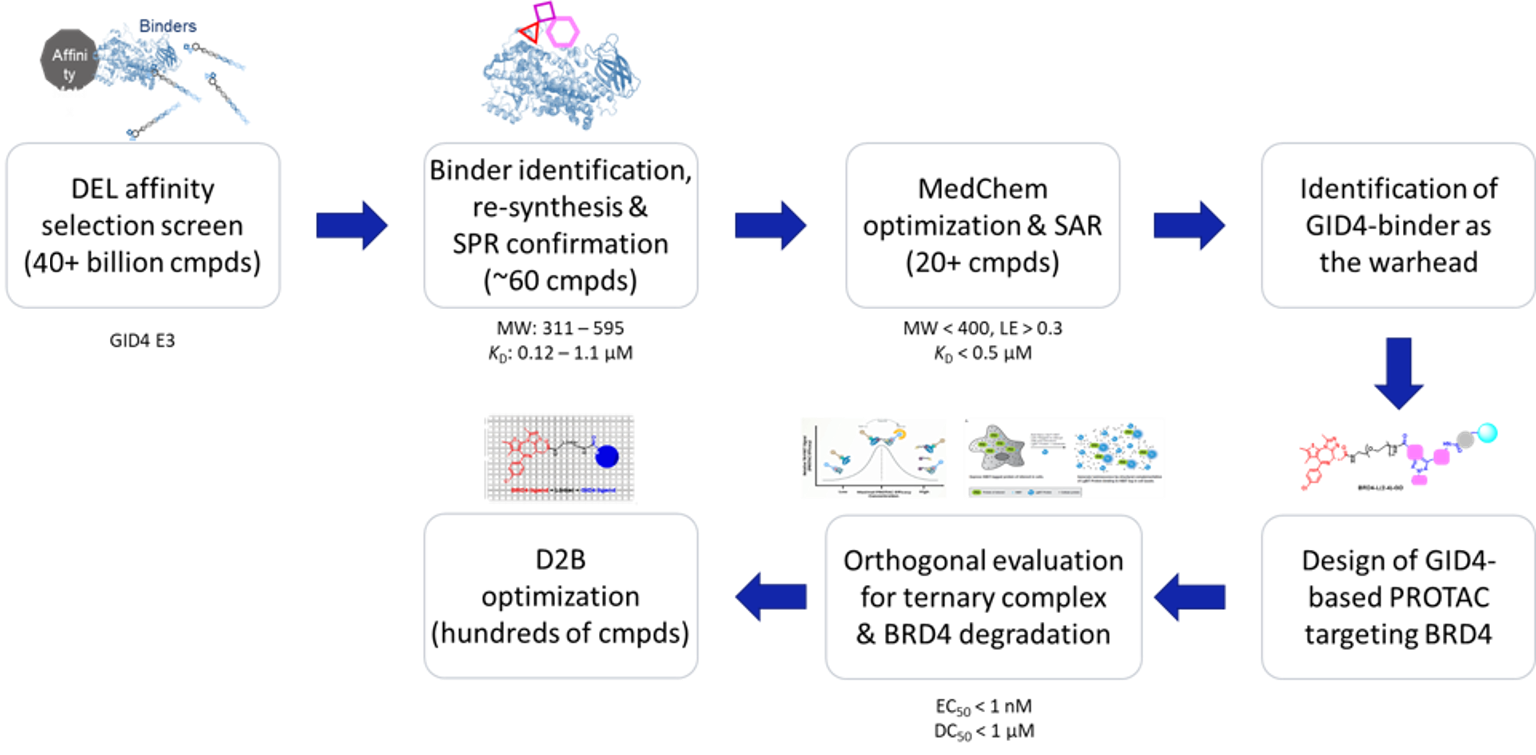
▲The D2B strategy supports SAR studies and accelerates the optimization of proteolysis-targeting chimera molecules (Image source: WuXi Biology)
“As highlighted at this year’s AACR meeting, the field of TPD is rapidly expanding beyond a handful of classical E3 ligases into a more diverse and complex landscape of novel ligases, raising the bar for drug discovery capabilities,” noted Dr. Wenji Su, Head of Discovery Biology Platform at WuXi AppTec, “WuXi AppTec has established an integrated discovery platform for TPD, bringing together diverse screening technologies with Direct-to-Biology (D2B) solutions. This platform enables the efficient identification and optimization of novel E3 ligase ligands within increasingly complex chemical space, accelerating the innovation of TPD therapeutics.”
Over the past decade, TPD therapies have risen rapidly, with expanding pipelines spanning oncology, immune diseases, neurodegenerative disorders, and beyond. For example, the proteolysis-targeting chimera Veppanu (vepdegestrant) targeting the estrogen receptor (ER) was recently approved by the U.S. FDA, offering a new treatment option for patients with ESR1-mutant HR+/HER2- breast cancer. Another next-generation molecular glue, iberdomide, is also expected to complete FDA review this year for relapsed or refractory multiple myeloma.
The strong promise of TPD therapies has also attracted significant investor interest. Recently, Neomorph announced the completion of a $100 million Series B financing round to advance its molecular glue degrader NEO-811 into Phase 1/2 clinical trials.
Due to their structural complexity and relatively large molecular weight, these traditionally “undruggable” TPD molecules place higher demands on platform capabilities.
As early as 2016, when TPD research was still in its early stage, WuXi AppTec had already made forward-looking investments in this field, establishing an integrated enabling platform that combines discovery, synthesis, analytical purification, and testing capabilities. With the emergence of new TPD modalities, the platform now supports a broad range of molecular types, including proteolysis-targeting chimeras, regulated induced proximity targeting chimeras, molecular glues, autophagy-targeting chimeras (AUTACs), lysosome-targeting chimeras (LYTACs), deubiquitinase-targeting chimeras (DUBTACs), ribonuclease-targeting chimeras (RIBOTACs), phosphorylation-inducing chimeric small molecules (PHICS), and degrader-antibody conjugates (DAC).
Looking ahead, as more previously untapped E3 ligases are unlocked, the landscape of TPD therapies will continue to expand, revealing an increasingly vast space for drug discovery.
Throughout this journey, WuXi AppTec will continue to enable global customers with its integrated, end-to-end CRDMO platform, accelerating the development and manufacturing of innovative therapies such as TPD, and helping customers accelerate drug development for patients worldwide.